
The Complete Guide to:
Crack GRE Reading Comprehension | Tips & Strategies
Table of Contents
1 GRE RC introduction
2 Types of Passages in RC
3 What does an RC Passage contain?
4 Elements of an RC Passage
5 RC Passage Types
6 RC Passage Type and Example: Exposition
7 RC Passage Type: Argumentative
8 RC Passage Example: Argumentative
9 Strategy for Long Passages
10 GRE Reading Comprehension Tips
Reading comprehension is probably the most intimidating part of the GRE Verbal section. Unfortunately, these passages are only getting tougher.
As an aspiring candidate, you might have a lot of questions, such as:
- How do I improve my GRE Reading Comprehension skills?
- How many Reading Comprehension questions are there?
- How can we solve Reading Comprehension passages quickly?
- What are some excellent Reading Comprehension strategies?
- How can I crack difficult GRE Reading Comprehension passages?
These are some of the questions that will be answered in this article.
Chapter 1
Introduction to GRE Reading Comprehension
Even though reading has always been an important skill and one that has been inculcated in us throughout our schooling, most of us still struggle with Vocabulary and Reading Comprehension. But in the case of GRE Reading Comprehension (or RC) passages, it is not sufficient just knowing how to read. To answer the complex questions that accompany these RC passages, it is also essential to have a clear understanding of the overall structure of a passage and what information the author is attempting to convey.
It might sound challenging, but with the right strategies and techniques and, of course, diligent practice, achieving a high score in GRE Reading Comprehension need not be an impossible dream. But before we get into that, here is a brief introduction to GRE Verbal Reasoning.
The sections in the GRE are broadly classified into two categories—Quantitative Reasoning and Verbal Reasoning. There will be two of each of these sections, along with an Unscored or Research Section. In addition to these, there is also the Analytical Writing (or AWA) section. Reading Comprehension is one of several question types that fall under the Verbal Reasoning section.
What is Reading Comprehension?
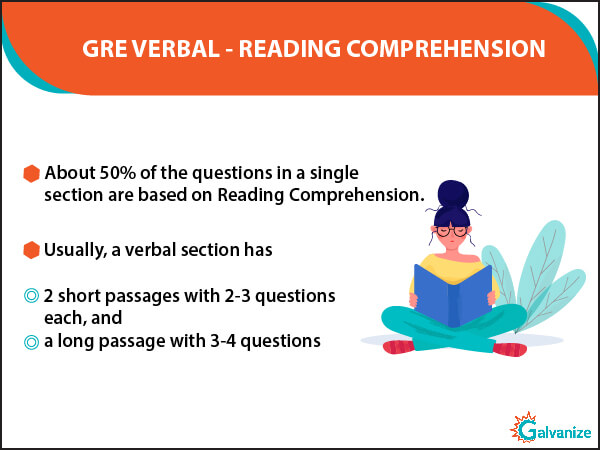
It is the ability to read and process a text effectively. Considering that about 50% of all the questions on the GRE Verbal will be Reading Comprehension questions, it is safe to say that this is one of the most important skills tested on this exam. To get an idea of how many Reading Comprehension questions one can expect across two sections, here is a rough estimation: 1 long passage: 4 questions, 5-6 Short passages: 1-2 questions each, 2-3 Medium passages: 2-3 questions each, and 3-4 Critical Reasoning questions (which are short argumentative paragraphs where we need to identify the flaw in the reasoning).
Remember, there will be two full verbal sections in the GRE, maybe even three, so it is necessary to be prepared for a lot of reading.

Chapter 2
Understand passage types in RC
Why is it necessary to understand GRE RC passage types? How will that help achieve a high Verbal score? Well, understanding passage types can provide a clear idea of what to expect and what to look for in a passage. Just a brief perusal of the introductory lines in a passage will tell us what kind of content the rest of the paragraphs hold.
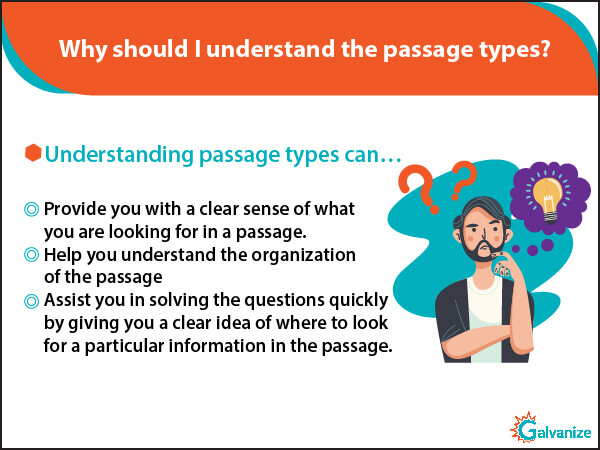
Once we have this clarity, it will be simpler to understand the organization of the passage as well, which is the structured presentation of information to help the reader make logical sense of the content. The structure also plays a key role in helping to solve questions accurately. Knowing where to find certain points in the passage will make it easier to answer the corresponding questions quickly. Moreover, understanding the organization of an RC passage means grasping its mechanics, which will help answer the notoriously difficult Main Idea and Primary Purpose questions.
To know where you stand, you can test your current knowledge with these free online Reading Comprehension practice questions.
If you’re looking for more RC practice questions, why don’t you try our free GRE App?
Chapter 3
What does an RC Passage contain?
So what can we find in a GRE RC passage?
To begin with, it is important to remember that any GRE RC passage is a logical flow of information. Generally, any piece of writing should have some logical flow of information—a main idea or fact intentionally presented to convince the reader, with each sentence of exposition linked to the next to create a narrative. In that sense, any piece of text would be logically structured, so it goes without saying that the GRE RC passages would also follow this basic rule.
But content is equally important in the GRE. While GRE Reading Comprehension passages can be based on any topic, a certain level of complexity in language and sentence structure is maintained. As students attempting this exam will presumably pursue their higher studies abroad, the GRE aims to challenge test takers by presenting them with high-level academic texts they would encounter in their graduate studies. But rest assured, these passages are constructed in such a manner that anyone from any background can read and analyze them without the need for prior subject knowledge.
Now, the content in an RC passage is classified into different ‘categories’. Firstly, we have the introduction, which would be the first paragraph of a passage. This would help acquaint the reader with the primary idea, providing a premise of sorts before diving into the text. The introduction (or ‘background information’) also helps readers unfamiliar with the subject develop a basic understanding of what will be discussed in the passage.

The main body of a GRE RC Passage will be built around an argument and/or a claim. A claim is a statement that presents an idea. It generally presents an objective ideal that can be argued for or against. An argument supports one particular side of a claim. It generally presents evidence or reasons to bolster its defense. Evidence is used to support a claim or an argument, making it stronger and more effective.
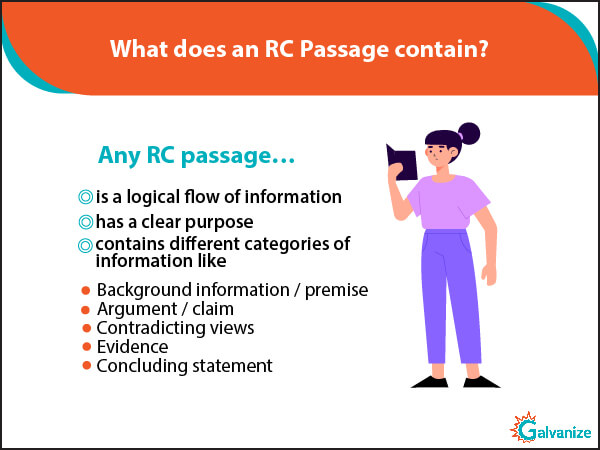
Apart from this, there are also contradicting/contrasting views. These are arguments that present multiple views (let’s say A, B, and C), all of which contend with one another.
Finally, we have the conclusion. Most conclusions either briefly summarize the main points in the passage or provide a suggestion or solution to some issue discussed. There are also passages that conclude on a thought-provoking note, allowing readers to form their own opinions. Whichever way it is presented, a conclusion should draw the passage’s narrative to a logical end.
This is a brief overview of what kind of information is contained within RC passages. Now, let’s take a closer look at some of these GRE RC passage elements. Make sure to pay attention because it’s easier to search for answers in an RC passage when one knows what to look for and where to find it.
Chapter 4
Elements of an RC passage
Now, consider that one encounter’s a passage on the GRE about a complex or unfamiliar subject—Marine Biology, for instance. Despite the complexity of the topic, the content in the passage will be at a level that anyone from any field can understand and process.
We saw in the earlier chapter that a claim is the central idea or focus of a GRE RC passage. A passage on Marine Biology will not and cannot cover all the different facets of the field. Hence, instead of a very generic passage, the RC passages on the GRE will usually be centered around a specific claim on a subject. There will be some background information given on that claim in the introduction to help familiarize the reader with the topic.
In some passages, there will be what is known as a problem statement—an idea contended inside the passage. The author of the passage might directly or indirectly raise certain questions regarding the central claim and might provide an argument for or against the main idea. Some authors would even seek to present a neutral stance and would discuss both sides of an argument. These arguments, along with reasons and evidence to support them, would make up the bulk of the passage.
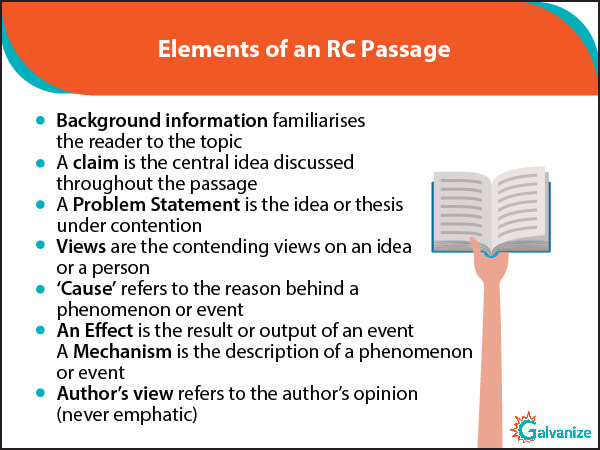
There might also be multiple contending views in a single passage. For example, consider a passage discussing the accomplishments of any particular historical figure. If that passage also mentions the different views of people regarding that figure (let’s say A, B, and C) then those are contending views. These viewpoints contradict each other, offering the reader different perspectives of the same personality, issue, or concept.
Then we have a cause, which is the reason behind any phenomenon or occurrence. An effect is the result or output of the occurrence. Note that a passage need not necessarily discuss both. We might find the cause of a phenomenon elaborated in a passage, but the effects need not necessarily be discussed, and vice versa. For instance, a passage on tidal waves might present the cause of this phenomenon but not explain the effects of this occurrence on the environment. Understanding the ‘category’ of information being presented in a passage is important.
Additionally, there is a mechanism, which refers to any description of a phenomenon or an event. So, while the cause tells us why an occurrence (let’s say ‘X’) happened, and the effect explains the results of ‘X,’ the mechanism would be the process of how ‘X’ occurred. The mechanism would provide the reader with all the stages or steps involved in ‘X.’
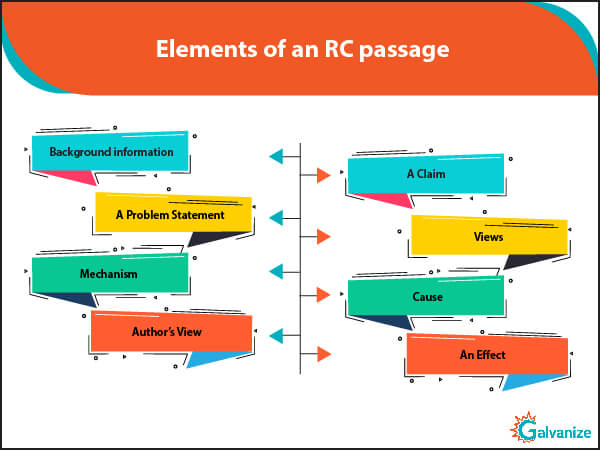
Finally, there is one more aspect of GRE Reading Comprehension that is a bit difficult to identify, and that is the author’s viewpoint. This is the opinion of the author of the passage on the claim they have elaborated on. In GRE RC passages, the author’s view is generally not an emphatic or obvious point. In the majority of these passages, the author will take on a neutral stance or only leave a subtle hint regarding their own opinion. Passages where the author outright supports or rejects a viewpoint are few and far between. Hence, the author’s tone also plays a key role in identifying the author’s view. We will look at some examples later to get a better idea of how this functions in an RC passage.
Chapter 5
Types of Reading Comprehension passages
Now that we are familiar with the elements of a GRE Reading Comprehension passage, let us take a look at the two broad categories of RC passages. With the help of examples, we can observe how the elements discussed earlier function in each type of passage.
The first category is Exposition. This type of passage provides a comprehensive description of an idea or theory. The main focus of these factual passages is to describe something. This could be anything—a concept, a phenomenon, an event, or even the history of some famous figure. These passages do not try to advance an argument but only intend to provide information.
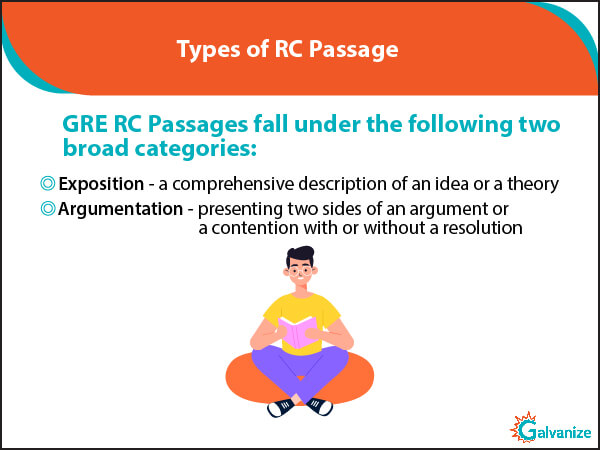
The other type is Argumentation. Argumentative passages present two or more sides of an argument or contention. Keep in mind that these passages need not necessarily have a resolution or obvious result. Most such passages would just cogently present two sides of an argument, possibly provide the author’s opinion at the end, and leave the reader to form their own conclusions.
These are the two broad categories of RC passages that can be found on the GRE.
Chapter 6
RC Passage Example & Type: Exposition
Now that we know the two primary types of Reading Comprehension passages, let us look at examples and try to identify the elements we discussed earlier. This will make it easier for us to understand the structure and tone of each passage and, consequently, allow us to recognize whether it is an expository or argumentative text.
First, let’s get a better understanding of Exposition-type passages.
While the order of elements may differ in an Exposition passage—for instance, in one passage, we might find the elements in the order A, B, C, while in another, in the order C, B, A—it will invariably contain these elements.
An expository passage will contain background information because, after all, it describes a phenomenon or an event. There will also be a claim or idea central to the passage.
Any one of these elements can be found in such a passage: cause, effect, or mechanism. These will aid in describing the occurrence and its effect. While we might not necessarily find more than one of these elements in a passage, there might be two or even all three elements, depending on the length and scope of the expository passage.
In addition to this, we might also find the author’s view in such passages. At the end of the expository text, the author may present what they think about the specific phenomenon/occurrence.
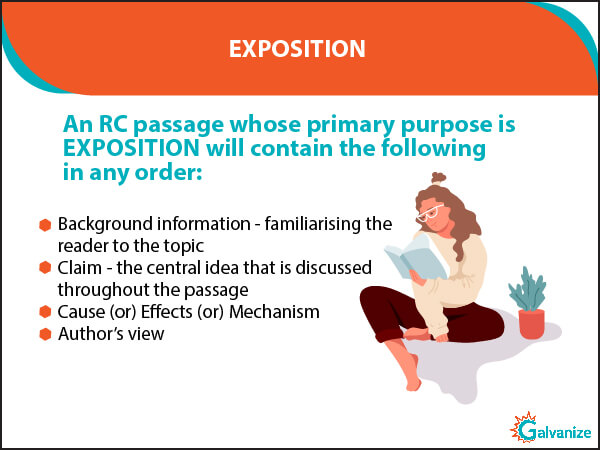
Keep in mind that this type of passage is an exposition—it introduces a topic and briefly describes a particular aspect of it. Hence, any and all of these elements could be found in such a passage.
Now, let us take a look at an expository RC passage to get a better idea of what we discussed. This is a relatively short reading comprehension passage. Nevertheless, let us read it and see if we can identify the different elements.
GRE RC Passage Example: Exposition
Reviving the practice of using elements of popular music in classical composition, an approach that had been in hibernation in the United States during the 1960s, composer Philip Glass (born 1937) embraced the ethos of popular music in his compositions. Glass based two symphonies on music by rock musicians David Bowie and Brian Eno, but the symphonies’ sound is distinctively his. Popular elements do not appear out of place in Glass’s classical music, which from its early days, has shared certain harmonies and rhythms with rock music. Yet this use of popular elements has not made Glass a composer of popular music. His music is not a version of popular music packaged to attract classical listeners; it is high art for listeners steeped in rock rather than the classics.
GRE RC Passage Explanation: Exposition
While this was quite a short passage, there is a lot of content, making it difficult to process. Let’s take it one sentence at a time and see if we can grasp its meaning.
The introductory sentence, “Reviving the practice…his compositions”, tells us that somebody
so we have the introductory sentence over here where the first chunk tells us that somebody revived a certain practice.
What was that practice? It was the practice of using elements of popular music in classical composition. From this first sentence alone, we can already understand that the main subject of this passage is music.
Next, we have two distinctions: classical music and popular music. According to the first sentence, we see that some popular elements are being used in classical composition. This practice “had been in hibernation in the United States”. ‘Hibernation,’ as you may know, is a phenomenon generally observed in animals, where they go to sleep for a long period of time during which they are not active. Hence, saying that the use of popular music elements in classical composition was in hibernation means that it was not widely pursued at the time (the 1960s) until composer Philip Glass came along and “revived” this practice.
Note the nuance—“revive,” here, implies that though this practice has always been around, it was not popular for a while. Hence, it was “revived” and brought back into practice. It is stated that “Glass embraced the ethos of popular music in his compositions,” meaning that he adopted the spirit of popular music and used elements of it in his compositions.
So just from reading the first sentence, what do we know about Philip Glass as a composer? What could be the context of the passage?
Let’s take a look at the second sentence, “Glass based…distinctively his.” This part of the passage discusses Glass basing two of his symphonies on the music of two musicians—David Bowie and Brian Eno—though the sound of the symphonies was distinctively his own.
So the information we can gather from this sentence is that though Glass used the music of Bowie and Eno as a foundation for his symphonies, he did not imitate them but rather produced his own sound. The main focus here is that Bowie and Eno were rock musicians, while Glass was a classical composer. Just from what we have read thus far, we can possibly infer that rock music would have been considered ‘popular music’ in the 1960s in the United States. This is further confirmed by the next sentence, “Popular elements do not…with rock music.”
This sentence concretely ties together the term “popular” with “rock music”. This sentence also helps the reader understand that having elements of rock music in what is supposed to be classical composition was not unusual since, from its early days, Glass’s music possessed rhythms and harmonies similar to rock music.
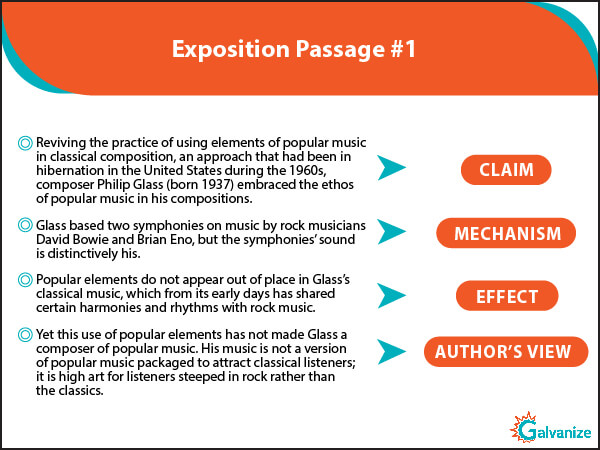
Let us now take a closer look at the next sentence of the passage, “Yet this use of…composer of popular music.” This tells us that though Glass used elements of popular music in his compositions, this practice did not make him a composer of popular music. He was still a classical composer.
The author has further elaborated on this statement, “His music is not…rather than the classics.” From this sentence, we can gather that the author believes that Glass’s work is not focused on making popular music appealing to classical music listeners but is a version of high art for listeners who prefer rock rhythms to classical music.
We have now understood the context of the whole passage. Thus, we can now state that there is only one claim being supported in this passage—the claim that Glass embraced popular music in his classical compositions. There are no different or contrasting views being presented.
This claim is further followed by the mechanism of how Glass incorporated elements from the rock music of Bowie and Eno in two of his classical symphonies.
Having read the passage, we know that this practice of incorporating rock music elements in classical composition was not unusual for Glass. Hence, the effect of his practice was not out of place.
Finally, we were able to discern the author’s view at the end of the passage. The author stated that Glass’s use of popular elements didn’t make him a composer of popular music, but rather, his work was viewed as high art by listeners who generally preferred rock music. We can easily identify this statement as the author’s opinion because it is not factual. It’s not a general statement but rather presents us with how the author feels about how Glass’s practice was viewed.
Thus, we have now concluded reading the passage and understanding its nuances. We know this passage talks about Philip Glass, advances a claim regarding his work, elaborates on the mechanism and its effect, and finally gives us the author’s own opinion. With this knowledge, we will now have a much easier time tackling the corresponding questions. This is the advantage of being able to recognize and understand the type, structure, and organization of the passage one is presented with.
Chapter 7
Passage Type: Argumentative
We have gained a good idea of what constitutes an expository passage. Let us now take a closer look at the argumentative type of passage.
There are certain elements that recur in most argumentative passages as well. Since the main goal of such passages is to make an argument, there will be a problem statement based on some issue.
This problem statement will be accompanied by some background information on the issue, followed by a few different views on the argument. One viewpoint will support one side, while another view will present reasons and evidence to support the other side.
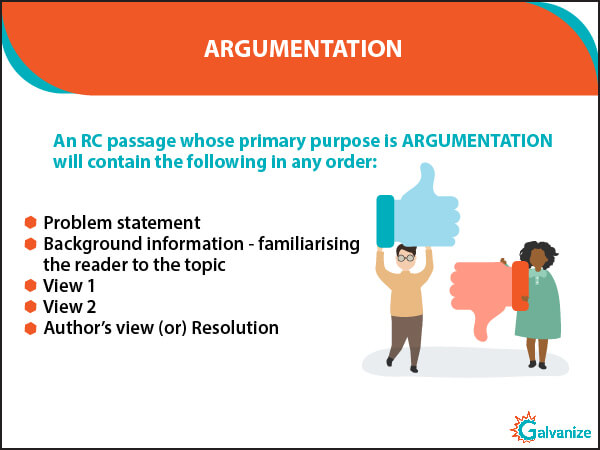
In addition to this, we can also expect the find the author’s view or a resolution to the problem. The author might favor one of the two sides of the argument, or they might prefer to present a neutral stance.
These are the different elements of an argumentative passage.
Chapter 8
Passage Explanation: Argumentative
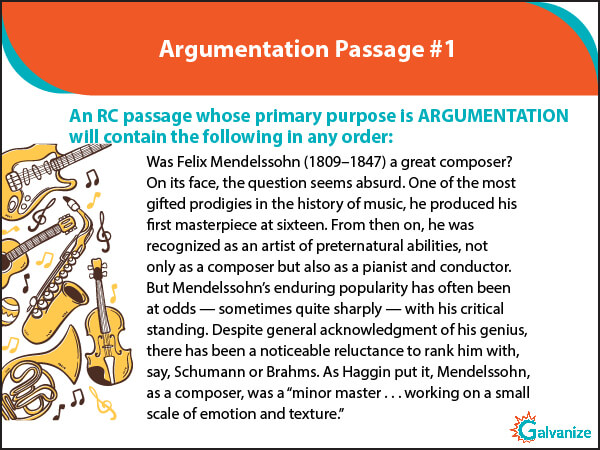
Let us now take a look at an example to get a better idea of the Argumentation passage type. Just a glimpse at the text informs us that it is about Felix Mendelssohn. There is a question, or rather, a problem statement, raised in the very first sentence: Was Mendelssohn a great composer?
What could this passage be about? There is a high chance that it will lead to an answer or resolution to this question, though there is an equal chance it might not.
Let’s keep reading.
The passage agrees that the initial question seems absurd, especially considering that Mendelssohn was “one of the most gifted prodigies in the history of music” who “produced his first masterpiece at sixteen.” What can we infer from this sentence? Mendelssohn was one of the most gifted musical geniuses not only during his time but in all of history. Moreover, he was a “prodigy,” which is “a young person with exceptional qualities or abilities.” This term is proved by him producing his first masterpiece when he was only sixteen years old. All these facts provide us with background information regarding the main subject.
What about the next sentence?
“From then on, he was recognized as an artist for his preternatural abilities…conductor.” Here, “preternatural” means ‘extraordinary.’ Many of us might be unfamiliar with such complex vocabulary, but during the GRE exam, there is no option of looking up the meanings of unfamiliar words. Hence, whenever one finds themselves in such a situation, the best thing to do is to attempt to gauge the meaning from the surrounding context.
This sentence has provided us with one view of Mendelssohn, particularly regarding his talents as a composer, pianist, and conductor. This seems to further support his status as a “gifted prodigy.” But the next sentence provides a contrast.
“But Mendelssohn’s enduring popularity…Schumann and Brahms.” This sentence brings us to the core of the problem statement. Though Mendelssohn is acknowledged as a genius, critics are reluctant to rank him among the greats in his field, like Schumann or Brahms. As a reader, we might be unfamiliar with these names. That is completely fine. As mentioned earlier, the passages in the GRE are curated in such a way that anyone from any background can understand them. Here, from the context of the sentence, we can discern that since critics were reluctant to rank Mendelssohn with Schumann and Brahms, the latter must also be well-known and accomplished musicians in the field. We do not need any background knowledge about Schumann or Brahms to make this inference.
Next, note the words “enduring popularity.” This implies that his popularity continues to be recognized. But this popularity was at odds with his reputation among critics. The word “sharply” is used to indicate the stark contrast between Mendelssohn’s popularity and his critical standing. This is the second viewpoint.
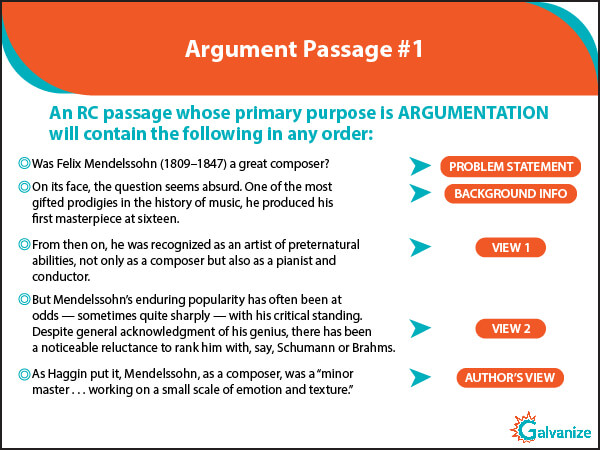
The next sentence sums up this argument according to the viewpoint of another individual. “As Haggin put it, “Mendelssohn as a composer was a “minor master…working on a small scale of emotion and texture”.” It is very common to see such quotations in GRE Reading Comprehension passages. They are usually inserted by the author to support one or the other views regarding the main argument.
In this case, Haggin has stated that Mendelssohn was a “minor master” who worked on “a small scale.” These phrases suggest that though Haggin acknowledges Mendelssohn as a “master” in music, he does not consider him great or important. Hence, this opinion seems to support the second viewpoint.
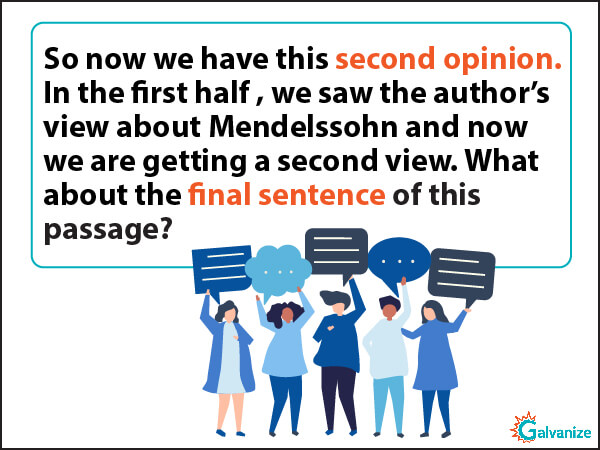
Now note the wording in this sentence. “As Haggin put it…” indicates that the author is in agreement with Haggin. The sentence structure, “As X says ABC…” is commonly used to indicate the author’s own agreement with the feelings or opinions of X. Hence, we can conclude that the author agrees that Mendelssohn was a minor master and was not a great enough musician to be ranked among other popular figures in his field.
Now, we have finished reading through this passage and understand its structure. We encountered a problem statement, got some background information on the subject, analyzed two different viewpoints, and finally inferred the author’s opinion supported by Haggin’s quote. We clearly understood how the argument was advanced and supported by different viewpoints and how it was concluded.
Hopefully, this should have been a sufficient introduction to the two types of GRE Reading Comprehension passages. By employing the same strategies during our personal RC practice, we should be able to efficiently tackle such passage structures.
Chapter 9
Strategy for Long passages
Here are some proven strategies to improve one’s reading comprehension skills in long passages.
Both of the RC passages discussed in the earlier chapters were relatively short, but long GRE passages are similar in structure to the shorter ones. They have all the same elements but typically provide more details. For instance, in a long argumentation passage, each viewpoint might be described in depth, with more reasons and evidence to support each side. However, the core structure and skeleton of the longer passages are similar to those of the shorter ones.
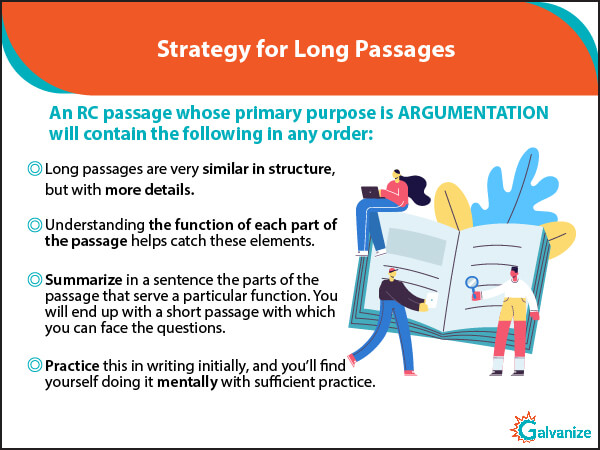
We know the two broad categories of passages. Be it a long one or a short one, the elements will be the same. Hence the first step is to identify what kind of passage one is presented with. This will make it simpler to understand the function of each part of a passage, though it might take comparatively a bit longer.
It would be good practice to try and answer these questions when practicing RC practices in general: Is it providing the author’s opinion? Does it have background information? What are the different elements in this passage? How do they work? Why has the author written this piece of text? What information are they trying to convey, or what point are they trying to make?

The best way to answer all these questions is to summarize the passage. It is important to do this as one reads the text the first time since spending additional time in reading the passage again to create a summary is time wasted.
Knowing the different elements in a passage can make it easier to create a summary. We can simply mark different sections of the passage as “background information,” “claim,” “view 1,” “effect,” “mechanism,” etc. This would provide us with a small guide to refer to when we require certain information from the passage, making it easier to narrow down the correct answers quickly. If one puts this method of summarizing into practice, there will be no need to read the passage over and over again.
Another thing to keep in mind, especially with the longer passages is to find the story. No matter how complex or long-winded a passage might seem, GRE passages always have a central story around which they are built. Identifying that story can make the passage more interesting for the reader.
Kick-start your GRE Prep
2000+ Practice Questions. 30+ hours of Video Lessons. 5 GRE like Tests. Personalized Feedback & more!
Go there!If we approach these passages with an open mind, they can be really interesting. For instance, many of the readers of this article might not have been previously aware of Philip Glass or his work. That passage might have inspired some and provided a new avenue to research and learn about, while for others, it might have just educated them a little. GRE RCs can be quite interesting if they are viewed outside the framework of a competitive exam!
It might seem tedious to have to follow all the steps listed earlier, having to identify elements, create a summary, and understand the author’s tone and viewpoint. However, these are all essential steps, and with practice, they will become a natural part of the reading process. Hence, it is necessary to get sufficient GRE RC practice to imbibe these key skills. If nothing, intense reading practice will help us gain an advanced reading ability that will be useful for the rest of our lives.
Now, look at the following comprehension passages with questions and answer them with the knowledge from this blog.
Chapter 10
GRE Reading Comprehension Tips
In the previous chapters, we have covered everything from how many RC passages you can expect on the GRE to the composition and elements of each passage in a section. Next, let us discuss some tips and strategies that can help us achieve a high score on these challenging questions.
The first point to keep in mind is to stop viewing these questions as challenging. This might seem contradictory, considering the statement made in the earlier paragraph, but approaching these questions with a negative, anxious mindset will only backfire.
Of course, that does not mean you take these questions lightly. There is a sense of time management that is crucial to succeeding in the GRE, and that can only be achieved by intense concentration and focus. Hence, you cannot read these passages like a newspaper or any other casual reading material.
That said, it is all about the balance! The GRE RCs can be fun. It might sound impossible, but it is possible to read, understand, analyze, break down the passage, and choose the correct answer within a short span of time. Here are some tips to help you along!
- Read slowly – If one is just beginning their GRE prep, time management should not be a primary concern. While practicing RCs, it is important to take time to read and understand each sentence and how it functions in the passage. This applies to those who are avid readers as well as those who do not read often. Reading slowly will hone the brain’s ability to process information completely and efficiently. As time progresses, the reading speed can gradually increase since the brain has already adapted to processing complex information faster.
- Speed reading is a sham – There is no such thing as speed reading, at least with regard to the GRE. Take the example of a student who reads for an hour every day up till their GRE exam. Initially, they read slowly and attempt to be analytical in their reading approach. However, with time, the student finds it easier to process information, and their reading speed increases. By the time they have to sit for the exam, the student burns through the passages and scores high.
If someone had witnessed this student’s GRE attempt, they might have been convinced that speed reading is real. However, the truth is that the student’s consistent, diligent effort every day helped improve their reading skills, not a practice such as speed-reading, which would cause one to miss crucial words and phrases in the text.
- Read relevant material – It is mentioned that the student in this example made reading a regular practice. But what kind of reading is appropriate for the GRE? Not every novel or comic will do. Since the language used in the GRE is quite complex, you will need to acclimatize your mind to reading such text, which can be found in journals, newspapers, and other advanced publications.
- Summarize before answering – Now, let’s move on to answering questions. Before looking at the questions, the most important thing to note is to read the passage properly and assimilate its ideas and arguments. This will help you answer questions more accurately and save time searching the passage for each question.
Consider that you are able to eliminate most of the options in a question. But you are stuck between two convincing options, and time is running out. How can you choose the correct answer?
- Read the question carefully. Is it asking for the reader’s perspective or the author’s? Are there any double negatives?
- Consider the most probable options. What is the difference between them? Which one is better supported by evidence from the passage? Is the word choice in the options similar to the words used in the passage? How is it structured? Has the meaning been tweaked?
- This is easier said than done, but aim for accuracy!
These tips should help change the way you approach RC questions. Read whatever subject brings you joy, but ensure you read from sources that mimic the language and complexity of the GRE. Reading will also invariably improve your vocabulary and knowledge, so there are only things to be gained from this practice!
GRE Reading Comprehension Practice Questions With Answers
Leave a comment below with the answers to the following questions.
Question 1
“Critical reading is a demanding process. To read critically, you must slow down your reading and, with a pencil in hand, perform specific operations on the text. Mark up the text with your reactions, conclusions, and questions. When you read, become an active participant.”
This paragraph best supports the statement that:
- Critical reading is a slow, dull, but essential process.
- The best critical reading happens at critical times in a person’s life.
- Readers should get in the habit of questioning the truth of what they read.
- Critical reading requires thoughtful and careful attention.
- Critical reading should take place at the same time each day.
Question 2
“There are no effective boundaries when it comes to pollutants. Studies have shown that toxic insecticides that have been banned in many countries are riding the wind from countries where they remain legal. Compounds such as DDT and toxaphene have been found in remote places like the Yukon and other Arctic regions.”
This paragraph best supports the statement that:
- Toxic insecticides such as DDT have not been banned throughout the world.
- More pollutants find their way into polar climates than they do into warmer areas.
- Studies have proven that many countries have ignored their own anti-pollution laws.
- DDT and toxaphene are the two most toxic insecticides in the world.
- Even a worldwide ban on toxic insecticides would not stop the spread of DDT pollution.
FAQS (Frequently Asked Questions)
What are the different sections of the GRE, and in which section can I expect RC questions?
- There are three main sections—Quants, Verbal and Analytical Writing.
- GRE RC comprises almost half of all GRE Verbal questions.
What are the elements of an RC passage?
- The different elements are—background information, claim, problem statement, views, cause, effect, mechanism, and author’s view.
What are the types of RC passages?
- Exposition (Description of an idea/a story)
- Argumentation (Presents two sides of an argument)
How can I effectively solve RC Passages? How do I ace Reading Comprehension in the GRE?
Understanding the elements of an RC passage and reading carefully through each paragraph would prevent the need to re-read a passage and waste valuable time. As for scoring well in RC questions, there is no better way than to practice consistently and diligently!
How many RC passages are there in the GRE?
Prepare yourself for about 5-7 RC passages in each of the Verbal sections.
Quick Summary:
- The GRE has five sections: 2 Quants, 2 Verbal, 1 Unscored or Research section, and the Analytical Writing section.
- GRE Reading Comprehension comprises about half of all Verbal GRE questions and, hence, is considered very important.
- GRE RC Questions: You can expect 2-3 Verbal sections on the GRE, with each section having about 5-7 RC passages.
- Understanding passage types helps to get a clear sense of what one has to look for in a passage.
- An RC passage has a logical flow of information, a clear purpose, and “categories of information.”
- Elements of an RC passage: background information, claim, problem statement, views, cause, effect, mechanism, and author’s view.
- Types of RC passages: Exposition (Description of an idea/story) and Argumentation (presents two sides of an argument).
- Elements of an Expository passage: background information, claim, cause or effects or mechanism, author’s view.
- Elements of an Argumentative passage: problem statement, background information, viewpoint 1, viewpoint 2, author’s view, and/or resolution.
Bonus RC Resources
now it's your turn
I'd like to hear from you
Which technique from today’s guide to the GRE Reading Comprehension are you going to try first?
Are you going to work on your GRE RC passages right away?
Or maybe you’re ready to start taking a few verbal tests.
Either way, leave a comment below right now.

Related Blogs
- How to Score a 160+ on the GRE Verbal | Tips, Pattern, Practice Questions & Scores
- A Killer Guide to Analytical Writing Assessment | With Samples for Practice
- GRE 101: A Complete Guide To GRE
- Free Online GRE Practice Test with Score Analysis
- Score a perfect 170 in GRE Math
- All You Need To Know About GRE Vocabulary
- GRE Quant :Time Management Tips











Really helpful for understanding the flow.
It was very useful
Good stuff
Really helpful for understanding the flow.
Really helpful how you have organized the stuff for a novice to understand GRE in the first go!!!
Very helpful information regarding RCs.
Helpful.
Good stuff for understanding the concept
Explained clearly in simplified way.
Answers: 1. d, 2. a
Well abd clear explanation about the RC topic.So helpful.