


All About TOEFL Exam (2023 Guide)
Exam Pattern, Cost, Dates, Scores & Validity , Format , Syllabus, Eligibility & Requirements, Exam Center's, Registration
Do you feel nervous when you think about taking the TOEFL exam? Well – take some comfort in the fact that you aren’t alone in feeling so! The thing to keep in mind is that the first step towards an excellent TOEFL score is knowing what the TOEFL is all about right from why/who needs TOEFL, how to prepare for it, the TOEFL exam pattern, different sections of the TOEFL, to exam dates, fees, and test centers!
You might be having a lot of questions like:
- What is considered a good TOEFL score?
- Is TOEFL easier than IELTS?
- How much does TOEFL cost?
- How long is the test and how long are the scores valid for?
- How many times can I take the TOEFL?
- How tough is TOEFL? Is it crackable? (Yes, it is!)
And so many more questions! We’ll answer all that here in detail. Here’s your Ultimate TOEFL guide. Let’s get to it.
Table of Contents
1. What is the TOEFL Exam?
• Difference between TOEFL iBT and PBT
• What is eligibility for TOEFL exam?
• How to register for TOEFL?
• TOEFL Exam Overview (TOEFL sections, Questions, Format, Test Length)
• TOEFL Preparation Duration
• TOEFL vs IELTS : Which one should I take?
2. Who accepts TOEFL scores?
• Countries that Accept TOEFL Scores
• How to view your TOEFL results? How to send your TOEFL scores?
• TOEFL to IELTS Score Comparison
3. How many times is TOEFL iBT test conducted ?
• Find available TOEFL dates and test center
4. What is the TOEFL Exam Fee?
5. What is the TOEFL score validity?
6. What is the TOEFL Exam pattern/TOEFL Section?
• TOEFL Reading Section
• TOEFL Listening Section
• TOEFL Speaking Section
• TOEFL Writing Section
7. TOEFL Sample Papers/ Practice Test
8. TOEFL Coaching
Chapter 1
What is the TOEFL Exam?
TOEFL Full Form:
The full form of ‘TOEFL’ is – ‘The Test of English as a Foreign Language’, and it is a test conducted by the Educational Testing Service (ETS). That’s right, the same people who conduct the GRE every year.
The TOEFL exam is conducted in two versions: Internet-based test (iBT) and Paper-based test (PBT). The TOEFL iBT was introduced in 2005 and is considered an upgraded version of TOEFL CBT (computer-based Test). Even though scoring on each section for both versions (iBT and PBT) is distinct, both versions have the same exam pattern. Of the two, 97% of students prefer to take the TOEFL iBT. Given the pandemic, most students have deemed it safer to take the TOEFL online in the interest of their safety. ETS has provided this option as well.
Difference between TOEFL PBT and TOEFL IBT:
|
Classification |
TOEFL PBT |
TOEFL iBT |
|
Full Form |
Paper Based Test |
Internet Based Test |
|
Exam Duration |
4 hours |
1 hour 56 minutes |
|
Venue |
Locations where the iBT® is not available |
Online |
|
Frequency of conducting |
4 times a year |
Over 50 times a year |
|
Exam Fee |
US$180 |
Location-specific payment in the local currency In India its INR 16900 |
|
Score range |
310 to 677 |
0-120 |
|
Exam Pattern |
Reading, Writing, Listening and Structure |
Reading, Writing, Listening and Speaking |
These sorts of questions naturally arise when students are looking to study abroad and get their certificates and scores of English Proficiency for the purpose of studying abroad. It is vital to establish your proficiency in the English language so that the university is assured of your ability to keep up with the coursework and your level of interpersonal communication. Knowing the language well (or not knowing it) isn’t necessarily a benchmark of your intelligence or ability. However, it is a necessary step, as the countries we frequently turn to for studying abroad, are primarily English-speaking countries.
The USA leans a lot towards the TOEFL for the purposes above and will serve as the aforementioned test of English Proficiency. TOEFL scores are needed by students in order to apply for colleges and universities in the USA and Canada.
Who can take the TOEFL Exam?
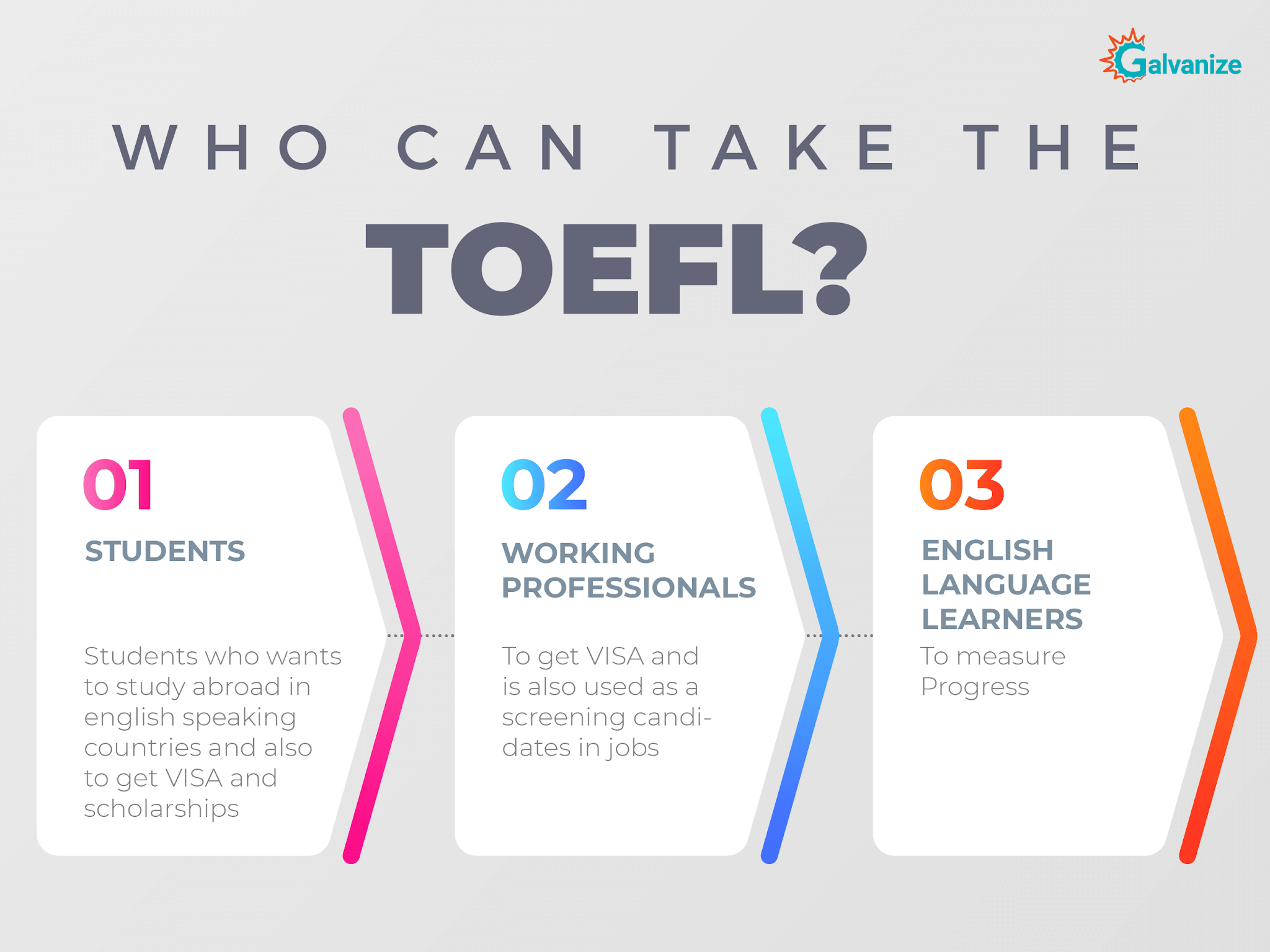
We know that a lot of universities ask for the TOEFL Score as a part of their admissions process, but where else are these scores used? Here’s a look:
- Students planning to pursue an academic course in an English-speaking country
- Working professionals applying for a visa to move abroad
- Students applying for scholarships and other certifications
- Those learning the English language can also take the TOEFL Exam to measure their progress
- Certain jobs ask for a TOEFL Score when screening candidates
There are universities and businesses in other English-speaking countries, like the UK or Australia, France, Germany, and so on who do accept a TOEFL score for various other purposes.
TOEFL Eligibility:
From the passages above, it is clear now that the TOEFL exam is taken by those who want to study abroad or work abroad. With regards to ‘TOEFL eligibility’, the good news is there is no eligibility criteria so to speak. Anybody could technically write the TOEFL exam.
Interestingly enough, there is no age limit to taking the TOEFL test! But in order to attempt the exam, you need to carry a valid passport as proof of identity at the time of the exam.
Even though there is no limitation to taking the TOEFL exam, if you plan to pursue your higher education at any university/college abroad, you do need to check the eligibility criteria set by the university.
TOEFL Registration:
You can register for the TOEFL exam at any time of the day and on any day of the week. You need to pay close attention while you are entering your details. ETS specifically mentions that the name with which you register for the TOEFL exam should be an exact match with the identification that you bring to the exam center.
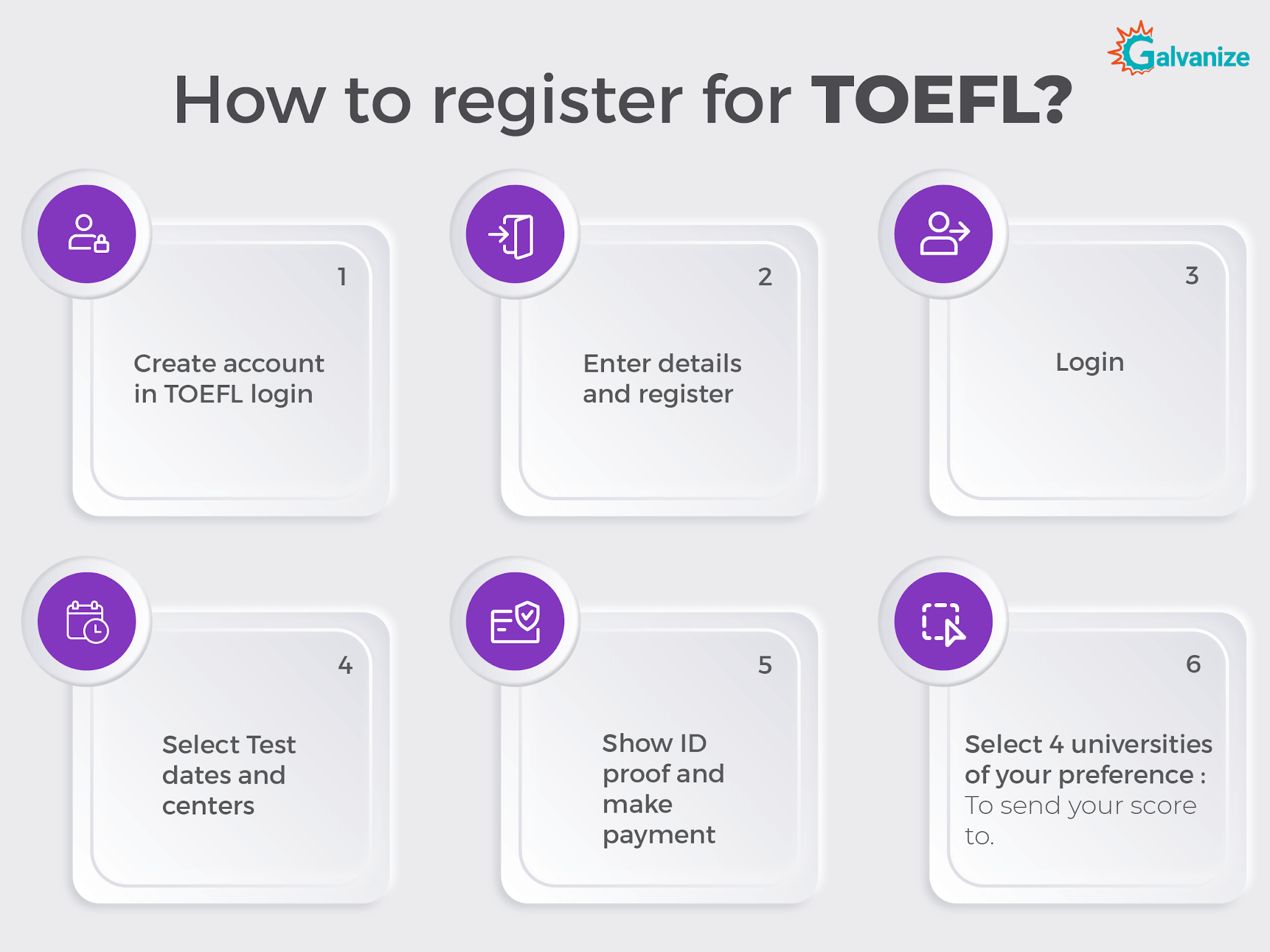
TOEFL registration closes 7 days before the test date but you can still register for the exam with a late fee of $40 up until 4 days before the exam.
- The first step to registering for the TOEFL exam is creating an account by visiting the “TOEFL login” page.
- Enter your personal information, address, and other important information regarding your country, language, and Background (like your field of interest, current education, and countries you wish to study, work or settle)
- Log in with the username and password you created and click on “Register/Find TOEFL Test Centers, Dates”.
- Enter your location and select the 2-month period in which you’d like to take the exam. You can also search through a restricted reservation code provided by the institution if applicable.
- Once you select the date you’ll be provided with the address of the test centers using which you can register immediately by providing proof of ID (Passport) and making the payment.
- You can also select four universities to which you want to send your TOEFL scores. You do have the option to add more universities with an additional payment of $20 USD for each university.
TOEFL Exam Overview:
|
TOEFL Full Form |
Test of English as a Foreign Language |
|
Conducted By |
Education Testing Services (ETS) |
|
Well-known as |
English Proficiency Test |
|
TOEFL Exam Fee |
INR 16,900(Payment can be done in local currency) |
|
Eligibility |
No specific Eligibility Criteria |
|
TOEFL Score Validity |
2 Years |
|
Official website |
|
|
TOEFL Exam Pattern |
TOEFL Exam Update: ( TOEFL Sections, Questions, Format, Test Length)
The ETS TOEFL exam received a few updates on August 1, 2019. These updates included changes in the TOEFL exam duration and in the number of questions in each section. Over the following 2 years, almost all TOEFL takers benefitted from these aforementioned changes. So, what were these changes?
For starters, the TOEFL exam duration was shortened by 30 minutes. The duration of test became 3 hours long with no changes in question types and format. However, the number of questions in the reading, speaking, and listening sections was reduced to lower the time.
Here is a quick comparison between the old version and the updated version of the TOEFL exam.
|
Section |
Old Version |
Version 1 (till July 24, 2023) |
New Revised Version(wef Jul 26, 2023) |
|
Reading |
3-4 passages 12-14 questions/passage 60-80 minutes |
3-4 passages 10 questions/passage 54-72 minutes |
2 passages 10 questions/passage 35 minutes |
|
Listening |
4-6 Lectures, 6 Questions/lecture 2-3 Conversations, 5 Questions each 60-90 minutes |
3-4 Lectures, 6 Questions/lecture 2-3 Conversations, 5 Questions each 41-57 minutes |
2-3 Lectures, 6 questions/lecture,1-2 conversations, 5 questions each 36 minutes |
|
Speaking |
6 Tasks 20 minutes |
4 Tasks 17 minutes |
4 Tasks 16 minutes |
|
Writing |
2 Tasks 50 minutes |
No change |
2 Tasks 29 minutes 1 Integrated Writing, 1 Writing for an Academic Discussion |
How long should I Prepare for TOEFL?
The ‘Test of English as a Foreign Language’ is one of the prerequisites for applying to any college or university in the USA or Canada. Essentially, anyone who wants to work or study abroad needs to prove their command over the English language by writing either the TOEFL or IELTS.
It doesn’t matter all that much whether you’re a student, a working professional, or an English language learner. Cracking the TOEFL is fairly straightforward! : )
The Internet version of the exam (around 97% of TOEFL takers choose the Internet version due to convenience) is around 3 hours long. It tests your Reading, Listening, and Speaking abilities, along with your writing skills. You can take the exam around 50 times a year. Universities do not fret about your TOEFL retakes (if any) and only require you to submit your highest TOEFL score to evaluate whether you meet their admission criteria. So that’s definitely some good news, right? Your scores will be valid for 2 years as well.
Without further ado, let us briefly jump into what the exam tests are. It is better to know and understand what you need to prepare before worrying about how long preparation will take.
Here’s a useful table from us that decodes the TOEFL Pattern concisely.
|
Section |
Question Types |
Time Limit |
No. of Questions |
Score Range |
|
Reading |
2 passages from academic texts (about 700 words); 10 questions per passage |
35 minutes |
10 questions /passage |
0 – 30 |
|
Listening |
2-3 Lectures |
36 minutes |
6 questions /lecture,1-2 conversations, 5 questions |
0 – 30 |
|
Speaking |
4 Tasks |
16 minutes |
4 tasks |
0 – 30 |
|
Writing |
1 integrated task (writing based on reading and listening); 1Writing based on Academic discussions |
29 minutes |
2 tasks |
0 – 30 |
Now that we have familiarized ourselves with the exam pattern, let us kickstart your TOEFL preparation!
- Read – The best way to improve your command of the English Language is by reading. It helps build your grammatical intuition and builds your reading stamina. As George Martin once said, “A mind needs books like a sword needs a whetstone, if it is to keep its edge.”
So go on and read for the heck of it! Read articles from online magazines and publications. Read novels and newspapers. Just read! This will also build your vocabulary.
- Learning the TOEFL Test Format – If you’ve been paying attention so far, you’d already know that the Exam Pattern is right above this section
- Picking the right TOEFL Preparation Class – The right study material, professional guidance and medium of teaching can save you 15 days’ worth of time w.r.t your TOEFL Preparation. Check out this practice test and see for yourself!
- Practice and take practice tests – The more you practice and familiarize yourself with the exam and its sections, the better you’ll know what to expect. Your scores will rise at a commensurate rate with quality practice. : ) You will also get used to typing online, which is not only useful for TOEFL but for IELTS and GRE as well.
In conclusion, one needs to keep all of the points mentioned above in mind and realize that the time it will take to prepare for TOEFL adequately is subjective, to say the least. You might take a month, or you might take just 10 days. It depends on where your love affair with the English Language began. If it hasn’t…start TODAY!
Which exam should you take? IELTS or TOEFL?
Firstly, let us get one thing out of the way. You have decided to write either of these exams as a requirement for getting into a school or university abroad or to immigrate and work in a particular country abroad. Having established this, we suggest you narrow down a few probable options in terms of universities. Which is your dream university or country? What do they prefer – IELTS or TOEFL? Identify this first and look into their requirements. In the end, that is what will matter after all.
On the other hand, if you haven’t narrowed down any possible university options, and are looking to hit them with your best shot in order to try your hand at all possible universities, then the following will be applicable for you!
Who accepts TOEFL scores?
Universities in the USA have preferred the TOEFL over IELTS for a long time, and if you are looking to study or immigrate to the USA, TOEFL is the better option. There are some universities that do accept IELTS scores as well, so definitely do your research beforehand. Around 9000 institutions in the world accept TOEFL scores, so do keep that in mind.
What about IELTS?
Similar to the TOEFL, even IELTS scores are accepted at around 9000 institutions in the world. The difference is that IELTS is preferred for programs in the UK and Commonwealth Nations such as Australia. European Universities also prefer IELTS scores.
So, there we have it. Your choice purely depends on where you wish to study or immigrate. Let us briefly look at the differences between these two counterparts.
Key Differences:
- Internet vs Paper Version: The TOEFL is primarily taken via the Internet whereas the IELTS offers both the Paper and Interne Version. If you’re someone who prefers writing physically in comparison to typing, then choose the right version for you.
- Multiple choice vs Type in the Answer Questions: The TOEFL is heavily MCQ-oriented, whereas the IELTS prefers the candidate to write short answers to the questions provided to them. The IELTS is more concerned with your thinking abilities.
- The Speaking Section: The TOEFL requires you to answer the provided questions or prompts in a recorded format, where there is no human presence apart from you. The IELTS on the other hand, has an actual human on the other side, listening to your conversation. Now, if you’re someone who prefers interacting with another person and find the conversation more stimulating this way, then the IELTS may just take the cake for you but if you find this intimidating, the TOEFL may resonate with you better. It depends on how you communicate and think.
- Reading Section: It is said that the IELTS uses myriad texts from sources such as academic readings, magazines, and online publications whereas the TOEFL makes use of academic texts only. The TOEFL may prove to be more challenging in this regard.
TL;DR: To sum it up, choose the exam that best suits your goals and needs, and that of the country or university you want to study or work in.
Chapter 2
Who accepts TOEFL scores?
There are 10,000+ colleges, agencies, and other institutions, and over 150 countries that accept TOEFL scores as of today and every year, over 50 computer-based tests are being administered via the Internet all over the globe.
Apart from universities, other organizations accept the TOEFL Score for different purposes.
As per ETS,
- Immigration departments use them to issue residential and work visas.
- Medical and licensing agencies use them for professional certification purposes.
- Individuals use them to measure their progress in learning English.
Even though the TOEFL Exam score is used for many purposes, it is mainly used by universities in English-speaking countries as a part of their admission process.
So, let’s see where these TOEFL Scores are accepted across the world.
- United States of America – Approximately 9 out of every 10 universities in the USA accept TOEFL scores and it is the most widely taken English-language test in the country.
- Canada – Over 75% of Canadian Universities accept the TOEFL Scores
- United Kingdom – More than 95% of Universities in the United Kingdom accept these scores
- Germany – The TOEFL Exam is preferred over any other English-language test
- New Zealand and Australia – All universities in Australia and New Zealand consider a TOEFL Exam score a reliable metric in their admission process
How to view your TOEFL results?
The TOEFL exam underwent a few upgrades on July 26, 2023. ETS has now included a section called “My Best Scores” which will give you the best individual scores of the writing, listening, speaking, and reading sections from all attempts in the last 2 years.
Also, you can view your score release date on the screen as soon as you submit your test.
So how do you check your score?
There is an advantage to taking the TOEFL exam in this regard. You can see the score release date on the screen as soon as you submit your test.
You can log in to your ETS account and check your results by clicking on “view scores”. You can also download your PDF score report.
How to send your TOEFL scores?
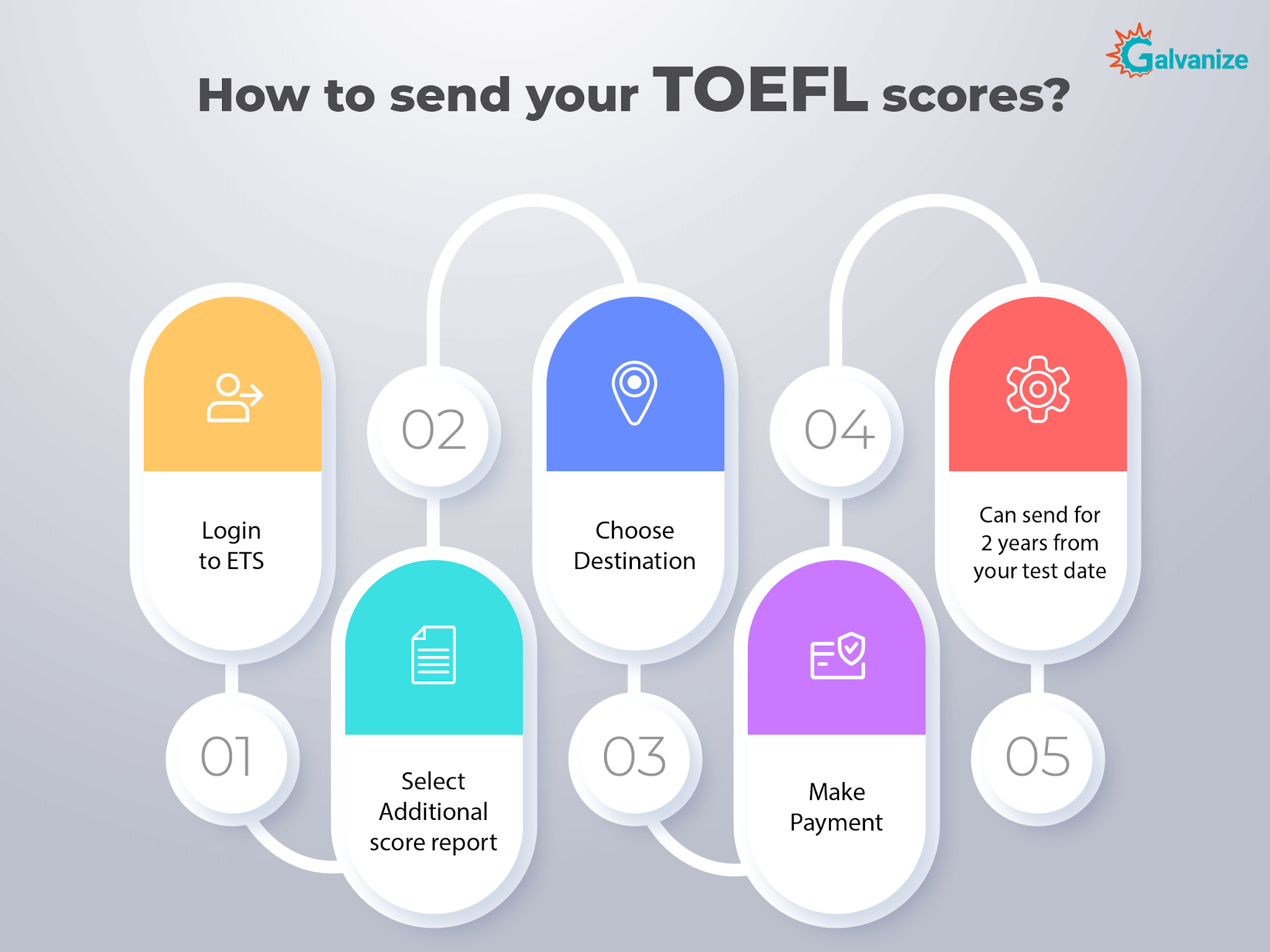
You can choose to send your TOEFL scores to 4 institutions before taking the test i.e., while registering for the test. The exam fee that you will be required to pay during registration is inclusive of these 4 TOEFL destinations.
Additionally, you can also send your TOEFL scores to more than the aforementioned 4 destinations at any time, with a fee of US$20 per report per destination. After approximately 13 days, your score reports will be sent to the destinations you have chosen.
TOEFL to IELTS Score Comparison:
As per ETS, most of the test scores in the range of 46 to 109 on TOEFL iBT and 5.5 to 7.5 on IELTS exam.
Below is the ETS report for detailed score comparison on IELTS and TOEFL.
| TOEFL Score | IELTS Score |
|---|---|
| 118‐120 | 9 |
| 115‐117 | 8.5 |
| 110‐114 | 8 |
| 102‐109 | 7.5 |
| 94‐101 | 7 |
| 79‐93 | 6.5 |
| 60‐78 | 6 |
| 46‐59 | 5.5 |
| 35‐45 | 5 |
| 32‐34 | 4.5 |
| 0‐31 | 0-4 |