Carnegie Mellon University Admissions: Requirements, Scholarships & Application Tips

Key Takeaways
- CMU admissions is holistic — there is no checklist and no minimum scores; the whole person counts.
- Narrative beats credentials — connect the dots between what you have done and where you are going.
- Your authentic, specific story is your edge — it is the one thing AI cannot replicate.
- Quality of experience beats quantity — depth and impact matter more than a long activity list.
- Very few students pay full price — merit aid is considered for every admitted candidate (CMU's average award that year was around 40%, per the session), so always ask.
Table of Contents
- About Carnegie Mellon University
- Admissions Is Holistic — There Is No Checklist
- The Biggest Mistake: Credentials Over Narrative
- What Makes a Strong Essay or Statement of Purpose
- Quality of Experience Beats Quantity
- Scholarships and Funding
- Test Scores: No Minimums in a Holistic Review
- US vs Indian Admissions
- Resilience: Focus on What You Can Control
- Human Skills in an AI Economy
- How Galvanize Helps With Your CMU Application
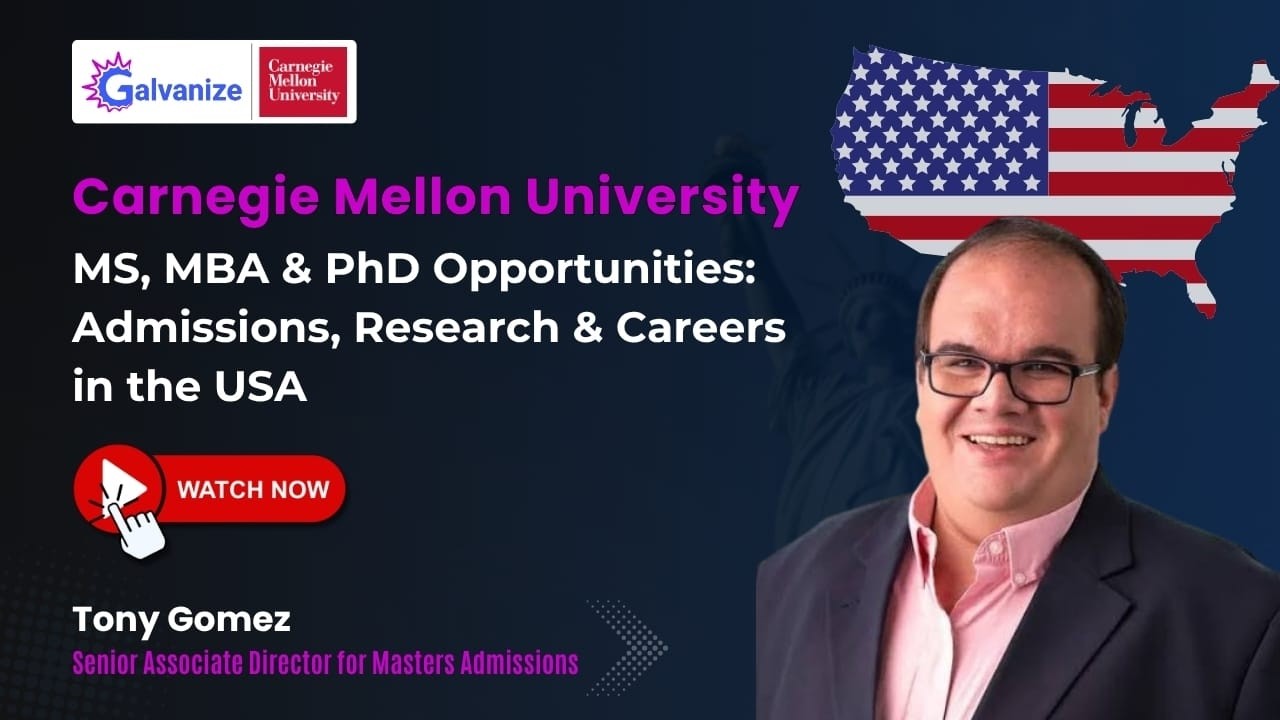
Getting into Carnegie Mellon University (CMU) is about far more than test scores. In a live Galvanize masterclass, Dr. Tony Gomez, Senior Associate Director of Master’s Admissions at Carnegie Mellon’s Tepper School of Business, walked through how CMU actually evaluates applicants, what a strong application looks like, and how funding works. This guide distils his key points — what CMU looks for, discussed with an admissions expert — and you can watch the full session below.
About Carnegie Mellon University
Carnegie Mellon University is a private research university in Pittsburgh, Pennsylvania, known for its interdisciplinary approach to research and education. CMU is consistently ranked among the top universities in the United States and is especially well regarded for its computer science and business programs. Rankings shift year to year, so check CMU’s official pages for the latest figures before you apply.
Admissions Is Holistic — There Is No Checklist
Tony’s central message was that CMU’s review is genuinely holistic. There is no single checklist and no fixed formula; the committee looks at the whole person. When applicants ask who the “ideal candidate” is, his answer was simply: you. The committee weighs not just what you have done, but how you think and how you plan to get where you want to go.
The Biggest Mistake: Credentials Over Narrative
The most common mistake Tony sees is applicants who over-focus on credentials and under-invest in the narrative of their application. Strong candidates connect the dots between their experiences and their goals, rather than leaving the reader to assume the connection. If you don’t tell that story, the admissions team is left to guess — and that works against you.
What Makes a Strong Essay or Statement of Purpose
An average statement, Tony explained, simply lists accomplishments and where you ended up. A strong statement takes the reader on the journey: it is specific, authentic and reflective, so the reader feels they are getting to know the real person. He also cautioned against leaning on AI to write your essays — AI cannot replicate your lived experience or your emotion, and authenticity is exactly what admissions committees are looking for.
Quality of Experience Beats Quantity
Many applicants believe that accumulating activities is the key to a strong profile. Tony’s advice was the opposite: it is the depth and impact of your experiences that count, not the number of them. If you cannot speak to what an experience meant and what you achieved, it does little for your application.
Scholarships and Funding
On funding, Tony’s reassuring message was that very few students pay the full sticker price. Merit-based aid is considered for every admitted candidate — in the session, Tony noted that CMU’s average award that year was around 40% — and it is always worth engaging the admissions office about your options. Availability, amounts and deadlines vary by program, so check the financial-aid page for the specific program you are applying to.
Test Scores: No Minimums in a Holistic Review
For anxious test-takers, Tony was clear: because the review is truly holistic, CMU does not set rigid minimum scores. He has admitted students whose scores some might consider modest, because other elements of their application made them stand out. A strong overall profile can offset a lower score — though you should still confirm each program’s current expectations.
US vs Indian Admissions
Tony drew a useful contrast for international applicants: the US process is a holistic evaluation of the whole person — the sum of your experiences — whereas admissions in India often comes down to tests, marks and which school you attended. Understanding that difference helps you present yourself the way US committees actually read applications.
Resilience: Focus on What You Can Control
With visa and job-market uncertainty on many applicants’ minds, Tony’s guidance was to focus on the elements you can control — building skills, gaining experience and developing your network — rather than the factors you cannot. He was candid that the journey involves hearing “no” more often than “yes,” and that persistence matters.
Human Skills in an AI Economy
Looking ahead, Tony argued that while AI is excellent at automating tasks, humans still have to define problems, make sound judgments and lead people. Working at the intersection of technology, business and human behaviour, he suggested, is among the most valuable skill sets for the decade ahead — a useful lens when choosing a program and framing your goals.
How Galvanize Helps With Your CMU Application
Galvanize supports international applicants end to end — university shortlisting, profile building, SOP, LOR and essays, and test prep for the GRE, TOEFL and IELTS. If you are targeting CMU or a similar university, our counsellors can help you build an application that reflects what admissions teams actually look for.
Frequently Asked Questions
What does Carnegie Mellon (Tepper) look for in MS, MBA and PhD applicants?
A holistic profile. There is no single checklist — the committee weighs your academic record, your fit and goals, how you think, and the narrative that connects your experiences, not test scores alone.
Is there a minimum GRE or GMAT score for CMU?
In a truly holistic review, CMU does not set rigid minimums. A strong overall profile can offset a modest score, though you should confirm each program’s current expectations.
What is the biggest mistake applicants make?
Over-focusing on credentials and under-investing in the narrative. Strong applicants connect the dots between their experiences and their goals rather than leaving the reader to assume.
Does using AI to write my essays help?
No. AI cannot replicate your lived experience or emotion, and authenticity is what admissions committees value. Write essays that are specific, reflective and genuinely yours.
What funding or scholarships are available?
Merit-based aid is considered for every admitted candidate, and very few students pay full price — in the session, Tony noted that CMU’s average award that year was around 40%. Amounts, eligibility and deadlines vary by program, so check the program’s financial-aid page and engage the admissions office.
How does Galvanize help with US graduate applications?
End to end — university shortlisting, profile building, SOP/LOR/essays, test prep (GRE, TOEFL, IELTS) and application strategy.