Funded PhD in Biotechnology in Germany: DAAD, Max Planck, and Industry-Linked Research Paths

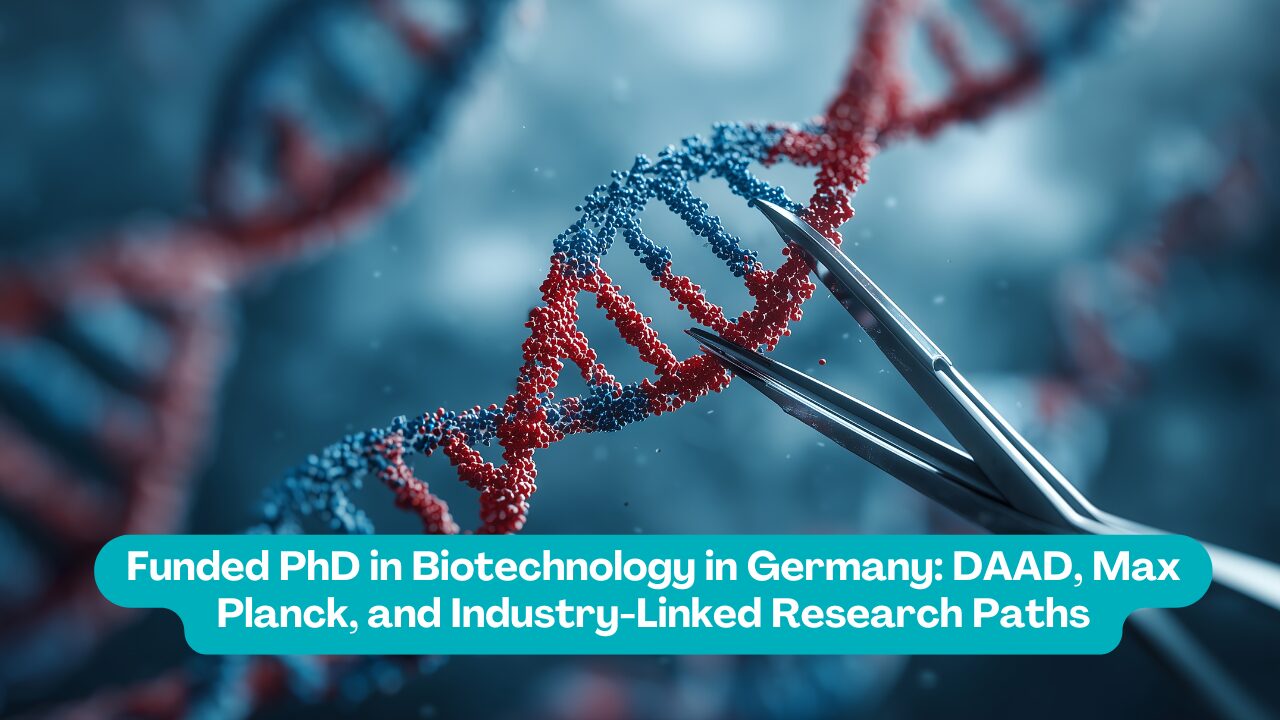
Table of Contents
- Why Germany for a Biotech PhD: Research Scale, Clusters, and Employer Demand
- PhD Models in Germany: Individual Doctorate vs Structured Programs (and What Suits Biotech)
- Target Institutes for Biotech PhDs: Universities, Helmholtz/Max Planck/Leibniz Labs, and Graduate Schools
- Finding Your Supervisor and Project: Where to Search, How to Pitch, and Timing Your Outreach
- Funding Routes: DAAD Research Grants, GSSP, and Institute-Funded Positions (What They Cover)
- Scholarship Databases and Calls: How to Scan DAAD, LSM, and Program Pages Effectively
- Biotech Clusters and Locations That Hire: Rhine-Neckar, Rhineland, Munich-Martinsried, and More
- Translational and Industry-Linked Pathways: IMPRS Groups, Max Planck Schools, and Tech Transfer
- Career Outcomes: Academia, CDMOs, Startups, and Big Pharma/Biotech in Germany’s Ecosystem
- Application Materials and Timelines: Research Proposal, References, and Typical Cycles
- Living and Lab Realities: Contracts, Salaries, and Daily Research Culture Expectations
- FAQs
Germany attracts over 28,000 international PhD students annually, making it the world’s most sought-after non-English-speaking destination for doctoral research . For aspiring scientists pursuing a PhD in Biotechnology in Germany, this translates into fully funded opportunities, access to cutting-edge laboratories, and direct connections to Europe’s thriving life sciences industry. With tuition-free education at public universities, collaboration with global pharmaceutical giants, and pathways into both academia and biotech entrepreneurship, Germany has emerged as a strategic launchpad for ambitious researchers worldwide. As someone who has guided hundreds of students into top-tier international programs over the past decade, I’ve witnessed firsthand how Germany’s biotech PhDs reshape careers and create lasting impact across the global scientific community.
Table of Contents
- Why Germany for a Biotech PhD: Research scale, clusters, and employer demand
- PhD models in Germany: Individual doctorate vs structured programs (and what suits biotech)
- Target institutes for biotech PhDs: Universities, Helmholtz/Max Planck/Leibniz labs, and graduate schools
- Finding your supervisor and project: Where to search, how to pitch, and timing your outreach
- Funding routes: DAAD research grants, GSSP, and institute-funded positions (what they cover)
- Scholarship databases and calls: How to scan DAAD, LSM, and program pages effectively
- Biotech clusters and locations that hire: Rhine-Neckar, Rhineland, Munich-Martinsried, and more
- Translational and industry-linked pathways: IMPRS groups, Max Planck Schools, and tech transfer
- Career outcomes: Academia, CDMOs, startups, and big pharma/biotech in Germany’s ecosystem
- Application materials and timelines: Research proposal, references, and typical cycles
- Living and lab realities: Contracts, salaries, and daily research culture expectations
- FAQs
- Primary Sources
- Conclusion & Call to Action
Why Germany for a Biotech PhD: Research Scale, Clusters, and Employer Demand
Germany sits at the crossroads of breakthrough scientific discovery and industrial-scale biotechnology innovation. The country hosts more than 700 biotech companies alongside pharmaceutical powerhouses and internationally acclaimed research institutions. This unique ecosystem creates unmatched opportunities for students committed to earning a PhD in Biotechnology in Germany.
International researchers gain several distinct advantages. Public universities charge minimal or zero tuition fees. Infrastructure rivals the best laboratories anywhere in the world. Regional biotech clusters like Rhine-Neckar and Munich-Martinsried provide immediate exposure to industry collaboration. Post-graduation work visas and strong employment prospects round out an already compelling value proposition.
Many students enter through a master’s degree first, building local networks and familiarity with German research culture. However, exceptional candidates with strong backgrounds can secure direct PhD admission. The system’s defining characteristic—its balance of academic independence and industry partnership—makes Germany an intelligent choice for researchers focused on long-term career returns.
PhD Models in Germany: Individual Doctorate vs Structured Programs (and What Suits Biotech)
Two distinct pathways define doctoral education in Germany. Understanding which model aligns with your working style and career goals matters significantly.
The individual doctorate gives you complete autonomy. You design your research project, develop hypotheses, and execute experiments under a professor’s mentorship. This approach dominates at German universities and research institutes. It suits self-directed scientists who thrive with minimal structure and maximum creative freedom.
Structured doctoral programs operate differently. You join a cohort of fellow researchers. Programs include coursework, transferable skills workshops, and formal mentoring frameworks. Graduate Schools, International Max Planck Research Schools, and Research Training Groups typically host these programs. They provide clearer guidance and stronger support networks, particularly valuable for international students navigating German academic culture for the first time.
For biotechnology specifically, structured programs offer compelling advantages. Lab rotations expose you to diverse techniques early. Industry partnerships create networking opportunities with pharmaceutical companies and startups. The cohort model builds lasting professional relationships across research groups. Students who complete a master’s degree in Germany often transition smoothly into these structured PhD pathways, leveraging existing institutional knowledge and academic connections.
Target Institutes for Biotech PhDs: Universities, Helmholtz/Max Planck/Leibniz Labs, and Graduate Schools
Germany’s research landscape operates through multiple interconnected systems, each offering distinct strengths for doctoral candidates.
Public universities like TU Munich, Heidelberg, and RWTH Aachen run established biotech PhD programs with strong faculty and modern facilities. Max Planck Institutes focus on fundamental and translational research, with IMPRS programs delivering English-taught doctoral training that attracts global talent. Helmholtz and Leibniz Institutes concentrate on applied biotechnology, bioinformatics, and medical research with direct clinical relevance.
Graduate schools provide another entry point. Programs like Life Science Munich and the Graduate School of Quantitative Biosciences structure doctoral education around interdisciplinary themes, combining biology with computational methods, physics, or engineering.
Most institutes maintain active industry partnerships and advertise funded positions regularly. Exploring program listings on Study in Germany and DAAD websites reveals the breadth of available opportunities across different research specializations and geographic regions.
Finding Your Supervisor and Project: Where to Search, How to Pitch, and Timing Your Outreach
Securing a position begins with identifying potential supervisors whose research aligns with your interests. Success requires strategic searching and thoughtful outreach.
Start by thoroughly exploring university and institute websites for advertised PhD projects. Use uni-assist and DAAD’s PhD database to discover opportunities you might otherwise miss. Attend virtual open days and specialized conferences where professors present their work. These events provide natural conversation starters and demonstrate genuine interest.
When you’re ready to make contact, craft concise, personalized emails. Attach your CV and clearly articulate your research interests. Mention specific publications or techniques from their laboratory that excited you. If you’ve completed a master’s degree in Germany, highlight that experience—it signals cultural familiarity and reduces perceived adjustment risks.
Timing matters considerably. Begin outreach eight to twelve months before your intended start date. Professors value proactive communication from well-prepared candidates who’ve done their homework. Generic mass emails rarely succeed. Targeted, thoughtful messages that reference actual laboratory work generate responses.
Funding Routes: DAAD Research Grants, GSSP, and Institute-Funded Positions (What They Cover)
Here’s encouraging news: the vast majority of positions come fully funded. Financial support typically flows through three primary channels.
DAAD Research Grants provide approximately 1,200 euros monthly, plus health insurance coverage, travel allowances, and support extending three to four years. These prestigious scholarships remain highly competitive but offer substantial security and independence.
The Graduate School Scholarship Programme targets structured PhDs specifically. Awards cover living expenses and program fees, allowing you to focus entirely on research without financial distraction.
Institute or project funding represents the most common pathway. You’re directly employed as a research assistant under TV-L E13 contracts. This includes regular salary, full benefits, and zero tuition charges. You’re essentially paid to complete your doctorate while contributing to active research projects.
Competition for funding intensifies each year. Strong academic credentials and relevant research experience become essential differentiators. Students who’ve completed master’s degrees in Germany often enjoy advantages, though international graduates with exceptional profiles compete successfully. Building a research track record during your master’s years strengthens applications considerably.
Ready to navigate funding applications with expert guidance? Explore how specialized graduate program counseling can sharpen your strategy and improve your success rate.
Scholarship Databases and Calls: How to Scan DAAD, LSM, and Program Pages Effectively
Maximizing your funding chances requires systematic database monitoring and smart search strategies.
The DAAD Scholarship Database serves as your primary resource. Filter results by biotechnology, life sciences, and PhD-level programs. Graduate school websites like Life Science Munich post regular calls for applications. Set email alerts for new project openings so opportunities reach you immediately rather than after deadlines pass.
Apply early in every cycle. Many calls close six to nine months before intended program start dates. If you’re completing a master’s degree in Germany, begin scholarship research during your final semesters. Early preparation dramatically improves application quality and demonstrates seriousness to selection committees.
Use specific search terms beyond generic keywords. Phrases like “molecular biotechnology,” “synthetic biology,” or “bioprocess engineering” surface specialized opportunities that broader searches miss. Cross-reference multiple databases to build comprehensive opportunity lists.
Biotech Clusters and Locations That Hire: Rhine-Neckar, Rhineland, Munich-Martinsried, and More
Germany’s biotechnology industry concentrates in distinct regional clusters. Your location choice influences internship access, industry connections, and post-PhD employment prospects significantly.
The Rhine-Neckar region around Heidelberg and Mannheim hosts EMBL, DKFZ, and numerous industry leaders. Collaboration density here creates exceptional networking environments. Munich-Martinsried clusters Max Planck institutes, Helmholtz centers, and a thriving biotech startup ecosystem around a single metropolitan area. The Rhineland spanning Cologne and Düsseldorf emphasizes pharmaceutical biotechnology and bioinformatics with strong ties to major companies.
Berlin and Dresden represent emerging hubs. Both cities attract biotech and medtech startups alongside established research institutes, creating dynamic environments where academic research quickly transitions into commercial applications.
Graduates from master’s programs in Germany often secure positions within these clusters, leveraging relationships built during their studies. Geographic choice isn’t merely about research quality—it shapes your entire professional network and career trajectory.
Translational and Industry-Linked Pathways: IMPRS Groups, Max Planck Schools, and Tech Transfer
Modern PhD programs increasingly bridge the traditional divide between academic research and commercial application.
International Max Planck Research Schools offer interdisciplinary projects frequently conducted in partnership with biotech firms. You gain exposure to both fundamental science and practical product development challenges. Max Planck Schools extend this model further, emphasizing translational research, entrepreneurship training, and technology transfer mechanisms that accelerate discoveries into marketable innovations.
Collaborative doctorates provide another pathway. Joint supervision arrangements with companies like Bayer, BioNTech, and Boehringer Ingelheim mean you split time between academic laboratories and corporate R&D facilities. This dual experience builds industry networks while you complete your doctorate.
These pathways substantially enhance employability by demonstrating you can navigate both research and business environments. Students who complete master’s degrees in Germany often access these elite programs more readily through existing institutional relationships and proven academic performance.
Career Outcomes: Academia, CDMOs, Startups, and Big Pharma/Biotech in Germany’s Ecosystem
A completed doctorate opens remarkably diverse career pathways across Europe and globally.
Academic careers remain traditional goals for many. Postdoctoral positions, group leadership roles, and eventually professorships become accessible across EU institutions. However, industry roles increasingly attract biotechnology PhDs. Positions in research and development, regulatory affairs, and clinical development at pharmaceutical and biotech firms offer competitive compensation and clear advancement paths.
Contract Development and Manufacturing Organizations represent a fast-growing employment sector. These companies require process engineers and scientists to scale production from laboratory to commercial levels. Startup hubs across Germany actively recruit PhD-trained founders and early employees who combine technical expertise with entrepreneurial ambition.
Post-PhD salaries typically range from 45,000 to 65,000 euros annually, with industry positions at the higher end. Many graduates from master’s programs in Germany leverage completed doctorates to secure permanent residency through EU Blue Card provisions, establishing long-term careers in Europe.
Application Materials and Timelines: Research Proposal, References, and Typical Cycles
Strong applications require careful document preparation and strategic timing.
You’ll need your CV, complete academic transcripts, and degree certificates from both bachelor’s and master’s programs. Research proposals typically span one to three pages, outlining your intended project, methodology, and expected contributions. Secure two to three letters of recommendation from academic referees who know your research capabilities directly.
Language proficiency documentation is mandatory. Programs accept IELTS, TOEFL, DSH, or TestDaF scores depending on whether instruction occurs in English or German. Your motivation letter should clearly connect your background, interests, and career goals to the specific program and supervisor.
Deadlines vary considerably by program type. Structured programs maintain fixed cycles, typically with December through March deadlines for autumn intake. Individual PhDs recruit year-round as funding becomes available. Plan twelve months ahead for smooth application processes. This timeline allows for document gathering, language test scheduling, and thoughtful research proposal development without last-minute pressure.
Living and Lab Realities: Contracts, Salaries, and Daily Research Culture Expectations
Understanding practical aspects helps you prepare for doctoral life beyond research itself.
Most PhD students receive employment contracts as research staff under TV-L E13 classifications at 50 to 65 percent FTE. Monthly net salaries range from approximately 1,800 to 2,400 euros after taxes and insurance deductions. This provides comfortable student living in most German cities, though Munich and Frankfurt cost more than Leipzig or Dresden.
Laboratory culture emphasizes flat hierarchies and collaborative environments. Work-life balance receives genuine respect, contrasting with more intensive research cultures elsewhere. While research typically proceeds in English, learning conversational German significantly eases daily life and expands networking opportunities.
Standard PhD duration spans three to four years. Project complexity may warrant extensions for completion. Students from master’s programs in Germany adapt quickly, already familiar with institutional norms, international team dynamics, and expectations around independent research productivity.
FAQs
Frequently Asked Questions
Can I apply for a PhD in Biotechnology in Germany directly after my bachelor’s?
Exceptional candidates occasionally gain direct admission, but most programs require completed master’s degrees. Pursuing a master’s degree in Germany substantially improves both admission chances and funding eligibility while building essential networks.
Are all PhD positions in Germany fully funded?
Nearly every advertised STEM and biotechnology PhD position includes funding through scholarships, research grants, or employment contracts. Always confirm specific funding details before accepting offers to avoid unexpected financial burdens.
What is the typical duration for a PhD in Biotechnology in Germany?
Most doctorates require three to four years depending on research complexity and funding terms. Structured programs may enforce stricter timelines than individual doctorates, which offer more flexibility.
Do I need to know German for a biotech PhD?
Research primarily occurs in English, and many programs deliver instruction entirely in English. Basic German proficiency aids integration and improves employment prospects after graduation, but isn’t mandatory for starting your doctorate.
How competitive are DAAD and Max Planck scholarships?
These remain highly competitive. Strong academic records, relevant research experience, and compelling motivation statements are essential. Completed master’s degrees in Germany and research publications strengthen applications considerably.
What are the visa and post-study work options after a German PhD?
Graduates receive eighteen-month job-seeker visas automatically. Most secure employment or postdoctoral positions, then transition to EU Blue Cards or permanent residency status within a few years.
Can international students bring their families during their PhD?
Yes. PhD students may apply for dependent visas covering spouses and children. You must demonstrate adequate funding and suitable accommodation for approval.
What support services exist for international PhD students?
Universities and institutes provide orientation programs, German language courses, counseling services, and career development resources. Alumni from master’s programs in Germany often form valuable peer networks that ease transitions.
**Conclusion **
Pursuing a PhD in Biotechnology in Germany delivers an exceptional combination of academic excellence, industry exposure, and outstanding return on investment. The country’s unique research infrastructure, from Max Planck Institutes to pharmaceutical partnerships, creates opportunities simply unavailable elsewhere. With structured programs providing mentorship, funding covering your entire doctoral journey, and biotech clusters offering direct pathways into employment, Germany has established itself as the premier destination for international biotechnology researchers. Success requires strategic planning, thorough preparation, and clear understanding of application processes, but the rewards—both immediate and long-term—justify the effort. Whether you aspire to academic leadership, pharmaceutical innovation, or biotech entrepreneurship, Germany’s doctoral ecosystem provides the foundation, networks, and credibility to build remarkable careers across the global life sciences landscape.
Also useful for Germany applicants:
Ready to transform your biotech ambitions into reality? Explore how expert graduate program counseling can guide you through every step—from selecting the optimal program to maximizing your funding success—and start building your path to a fully funded PhD in Biotechnology in Germany today.