Masters in International Relations in Germany: Top Universities, Costs & Career Paths

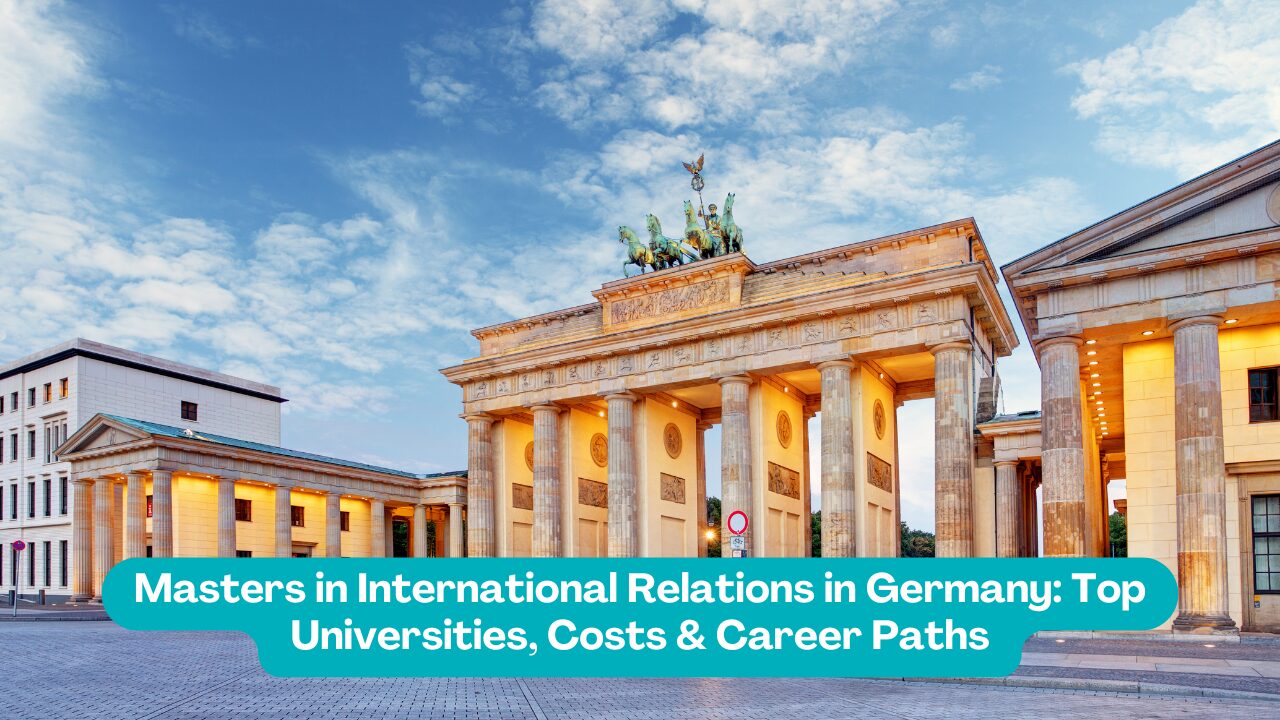
Table of Contents
- Why Choose Germany for a Masters in International Relations?
- Overview of International Relations as a Field of Study
- Eligibility & Admission Requirements for International Students
- Top Universities in Germany Offering International Relations Programmes
- English-Taught vs. German-Taught International Relations Programmes
- Tuition Fees, Scholarships, and Cost of Living in Germany
- Internships, Exchange Programmes & Research Opportunities
- Career Prospects in International Relations after Graduation
- Germany’s Geopolitical Role: Why It Matters for IR Students
- Tips to Strengthen Your Application & Boost Acceptance Chances
- Frequently Asked Questions
- Primary Sources
- Conclusion
More than 440,000 international students are enrolled in German universities today, a figure that has climbed steadily for the past decade as tuition-free public institutions, generous visas, and Europe-wide employability make Germany a magnet for ambitious talent. Among those degrees, a Masters in International Relations (IR) stands out for its unique blend of political science, economics, and law, taught in the very country that drives much of the European Union’s policy agenda. If you want to debate EU climate goals in the morning and intern at a Berlin think-tank in the afternoon, Germany offers a classroom that extends well beyond four walls. This guide breaks down everything you need to know, including admissions, funding, language options, and career ROI, so you can approach your application with the same strategic clarity that top policy analysts bring to global negotiations.
Why Choose Germany for a Masters in International Relations?
- Public university tuition ranges from €0 to €1,500 per semester, a fraction of what comparable programmes in France or the Netherlands cost.
- Graduates receive an 18-month post-study work visa, providing a practical runway to convert academic networks into EU-wide careers.
- Cities such as Berlin, Bonn, and Frankfurt host the European Central Bank, UN agencies, and more than 6,000 NGOs, turning coursework into real-time policy observation.
- According to the German Academic Exchange Service (DAAD), 47 per cent of international graduates remain in Germany for skilled jobs.
Overview of International Relations as a Field of Study
International Relations explores how governments, corporations, and multilateral bodies interact across borders. German IR programmes typically cover:
- Theories of International Relations and Foreign Policy
- European Governance and Integration
- International Economic Policy
- Human Rights and Conflict Resolution
Because many courses use case studies drawn from Germany’s own EU leadership, students gain both conceptual depth and regional expertise that employers value.
Eligibility & Admission Requirements for International Students
Most universities expect a bachelor’s degree with the equivalent of a German 2.5 GPA, an IELTS score of 6.5 (or TOEFL iBT 90) for English-taught tracks, and B2 TestDaF for German-medium programmes. Core documents include a résumé, statement of purpose, two letters of reference, and certified transcripts. Applications are routed either through the university portal or via the centralised Uni-Assist platform. A strategically written statement linking your objectives to Germany’s policy landscape can often compensate for a borderline GPA.
Top Universities in Germany Offering International Relations Programmes
- University of Heidelberg – M.A. International Relations (English, public, social fee ~€170)
- Hertie School Berlin – Master of International Affairs (English, private, scholarships up to 50 per cent)
- TU Dresden – M.A. International Relations (English/German, public)
- University of Erfurt – M.A. Global Public Policy (English, public)
All four institutions participate in Erasmus+, giving you a chance to study for a semester in Paris, Prague, or Milan while paying German tuition rates.
English-Taught vs. German-Taught International Relations Programmes
English tracks remove the language barrier and bring together cohorts where 40-60 per cent of students are international. German-medium programmes, however, open up a wider choice of universities and significantly improve employability for roles that require day-to-day interaction with local stakeholders. A common strategy is to start in an English-taught programme and reach B2 or C1 German by the third semester through university language centres or low-cost Volkshochschule classes.
Tuition Fees, Scholarships, and Cost of Living in Germany
Tuition at public universities is often free; private schools charge between €10,000 and €18,000 per year. A semester contribution of €150–€350 typically covers local transport. The German student-visa block-account requires €934 per month to demonstrate living expenses. Major funding sources include DAAD EPOS (full stipend), Heinrich-Böll Foundation (partial), and Konrad-Adenauer-Stiftung (governance focus). Many students offset 60 percent of costs by combining a scholarship with a 20-hour-per-week “mini-job” paying about €520 monthly.
Internships, Exchange Programmes & Research Opportunities
Germany’s dual-education culture integrates practical experience into degree structures. Expect to complete a three-month practicum at organisations such as GIZ or Deutsche Welle, earn Erasmus+ credits in Brussels, or assist faculty on projects funded by the Federal Foreign Office. These hands-on roles give graduates résumé lines that translate directly to policy, consulting, or NGO jobs.
Career Prospects in International Relations after Graduation
Entry salaries vary by sector: €45k–€62k in EU institutions, €38k–€55k in NGOs and think-tanks, and €50k–€70k in private-sector government-affairs teams. DAAD surveys show 71 percent of IR graduates secure relevant employment within a year. The EU Blue Card pathway makes it easier to parlay a German job offer into long-term residency.
Germany’s Geopolitical Role: Why It Matters for IR Students
As Europe’s largest economy and a diplomatic power broker, Germany influences climate talks, NATO strategy, and global development financing. Studying here lets you witness policymaking in action; 160 foreign embassies, the Bundestag’s Foreign Affairs Committee, and countless advocacy groups are all within a U-Bahn ride.
Tips to Strengthen Your Application & Boost Acceptance Chances
- Craft a purpose statement that connects your goals to Germany’s multilateral leadership.
- Quantify impact, “secured $12,000 in crowdfunding” reads stronger than “helped raise funds.”
- Combine one academic and one professional reference for a balanced recommendation portfolio.
- Target 15 December for winter-semester deadlines; scholarship decisions often precede admission notices.
- Use the DAAD Course Finder to validate programmes, then have your documents pre-checked through Uni-Assist.
Need personalised feedback on your SOP or scholarship essay? Book a Galvanize masters admission counselling session to optimise your profile before you hit “submit.”
Frequently Asked Questions
Is German language mandatory for English-taught IR programmes?
Admission is possible without German, but reaching B1–B2 level will improve part-time job options and post-study hiring prospects.
How competitive are DAAD scholarships?
DAAD EPOS accepts roughly 20 percent of applicants. Demonstrated work experience in governance or development plus a well-scoped project proposal increases your chances.
Can I work while studying?
Yes. Student visas allow 120 full or 240 half days of employment per year. Many IR students freelance in translation or policy research at €12–€15 an hour.
What visa do I need after graduation?
Apply for the 18-month Job Seeker visa, then transition to an EU Blue Card once you secure qualifying employment.
Do German degrees help in other EU countries?
Absolutely. Bologna-compliant credits and Germany’s strong employer brand facilitate mobility to Brussels, Paris, or Vienna.
How early should I start the application process?
Begin at least 12 months ahead; document legalisation, APS certification (for some non-EU degrees), and Uni-Assist evaluations can collectively take up to 10 weeks.
Are there fully online IR masters in Germany?
Few exist; Germany favours on-campus learning. If flexibility matters, consider hybrid formats at institutions such as FernUni Hagen.
What GPA is considered safe?
Public universities weigh overall fit more than perfect grades. A 2.5 German scale (~65 percent) combined with a strong narrative often suffices.
Primary Sources
- DAAD International Student Statistics
Conclusion
Also useful for Germany applicants:
A tuition-free or low-cost Masters in International Relations in Germany is more than a degree; it is an on-the-ground tutorial in European diplomacy, economic policy, and multilateral cooperation. By coupling world-class academic training with built-in internships, Germany ensures that you graduate not just with theoretical knowledge but with concrete experience, and the 18-month post-study work visa gives you ample time to translate that experience into a EU-wide career. Approaching your application strategically, securing scholarships, sharpening your language skills, and targeting universities aligned with your goals turns an already compelling offer into a life-changing investment. If you are ready to move from curiosity to concrete action, take the first step today and schedule your personalised admissions strategy session through Galvanize masters admission counselling.