Masters in Mechatronics Engineering in Germany: Your Fast-Track to Robotics, AI, and Industries 4.0

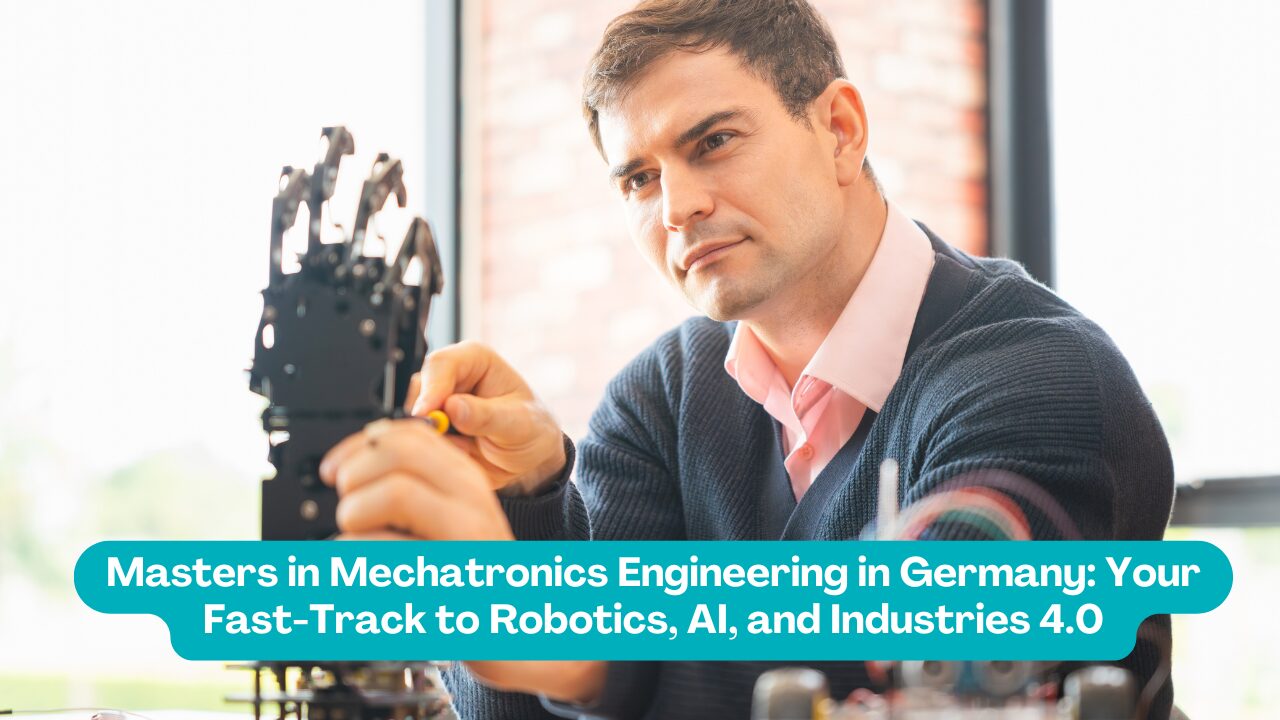
Table of Contents
- What Mechatronics Is Today: Core Pillars and Germany’s Role
- Program Formats and Length: 3 vs 4 Semesters, 90–120 ECTS
- Language Strategy: English-Taught vs German-Taught Modules
- Eligibility Realities: 210 ECTS, Bridging Modules, Upskilling
- Curriculum Deep-Dive: Robotics, Embedded Systems, AI Tracks
- Project-to-Employer Pipeline: Labs, Research, Working-Student Roles
- Demand Signals: Robot Density, EU Auto Investments, Ecosystem
- Thesis, Internships, and Dual or Part-Time Variants
- Application Timing and Documentation
- First Roles After Graduation: R&D, Automation, Integrators
- FAQs
- Conclusion
Germany is a global hub for advanced manufacturing, robotics, and intelligent systems, and this ecosystem makes it one of the strongest destinations for a
Masters in Mechatronics Engineering in Germany
. Public universities often charge no tuition, many programs are offered fully in English, and research and industry partnerships are deeply embedded in the curriculum. Students benefit from collaboration with industrial leaders and research organizations, strong investment in digitized production, and a policy environment that supports STEM talent. Graduates can transition into high demand roles in robotics, automation, embedded systems, and cyber physical systems, and can use post study work permissions to build long term careers in the European market. This guide explains programs, entry criteria, language strategy, curriculum design, internships, and early career pathways so that applicants can plan a realistic and high return route into mechatronics in Germany.
Table of Contents
What Mechatronics Is Today: Core Pillars and Germany’s Role
Program Formats and Length: 3 vs 4 Semesters, 90–120 ECTS
- Language Strategy: English-Taught vs German-Taught Modules
- Eligibility Realities: 210 ECTS, Bridging Modules, Upskilling
- Curriculum Deep-Dive: Robotics, Embedded Systems, AI Tracks
- Project-to-Employer Pipeline: Labs, Research, Working-Student Roles
Demand Signals: Robot Density, EU Auto Investments, Ecosystem
- Thesis, Internships, and Dual or Part-Time Variants
- Application Timing and Documentation
- First Roles After Graduation: R&D, Automation, Integrators
- FAQs
- Primary Sources
- Conclusion and Next Steps
What Mechatronics Is Today: Core Pillars and Germany’s Role
Mechatronics integrates mechanical engineering, electronics, control systems, and software to create intelligent machines and production systems. Typical pillars include sensing and actuation, embedded computation, controls and signal processing, real time software, and system integration. Germany’s university departments, applied research institutes, and industrial clusters provide extensive project opportunities that align with Industry 4.0 priorities. Well known organizations, including Max Planck, Fraunhofer, Helmholtz, and leading OEMs and suppliers, contribute topics for coursework projects, labs, and theses.
Program Formats and Length: 3 vs 4 Semesters, 90–120 ECTS
Universities offer two standard formats that both meet
Masters in Germanynorms.
Fast track programs, typically 3 semesters and 90 ECTS, suit applicants with a four year engineering background and strong prerequisites.
Standard programs, typically 4 semesters and 120 ECTS, allow broader foundations, more electives, or an extended thesis.
| Format | Typical Duration | ECTS |
| Fast track | 1.5 years | 90 |
| Standard | 2 years | 120 |
Choice should be based on prior credits, depth of preparation, and specialization goals. Public universities commonly charge only a semester contribution, which improves return on investment.
Language Strategy: English-Taught vs German-Taught Modules
Many Masters in Mechatronics Engineering in Germany
are fully English taught, especially at large research universities and in major cities. Some electives, labs, or seminars may use German, and internship and job searches benefit from B1 or B2 proficiency. Most universities provide free or subsidized German classes on campus. To review admissions and language policies, consult the
Study in Germany
portal and department pages, and consider structured support for applications through
uni-assist.
Eligibility Realities: 210 ECTS, Bridging Modules, Upskilling
Admission criteria typically include a bachelor’s degree in mechanical, electrical, electronics, instrumentation, or a closely related field, evidence of core mathematics and programming, and a competitive GPA. Some universities require 210 ECTS, which is common for European bachelor’s programs. Applicants with three year degrees may be asked to complete bridging modules or a preparatory semester. Language requirements vary by track, for example IELTS or TOEFL for English taught programs, and TestDaF or DSH for German taught programs. Credential checks and document submission workflows are usually managed through
uni-assist.
Curriculum Deep-Dive: Robotics, Embedded Systems, AI Tracks
A typical curriculum blends theory with extensive applied work. Core elements include
robotics and intelligent automation, embedded systems and internet of things, control engineering across linear and nonlinear regimes, modeling and simulation, computer vision and applied machine learning, and safety and validation for real time systems.
Electives allow specialization in areas such as mobile and industrial robotics, autonomous systems, mechatronic design, human robot interaction, medical devices, or automotive mechatronics. Programs commonly include multi week practicals and team projects that mirror industrial development cycles.
Project-to-Employer Pipeline: Labs, Research, Working-Student Roles
German programs emphasize application in real settings. Students complete laboratory courses, research projects, and often work part time as working students in engineering teams, typically up to twenty hours per week during the semester. Thesis projects are frequently co supervised with industry or applied research institutes, which supports direct hiring. This pipeline is a distinctive strength of
Masters in Germany
programs and contributes to strong outcomes for international graduates.
Demand Signals: Robot Density, EU Auto Investments, Ecosystem
Germany maintains one of the highest robot densities in Europe and continues to invest in electrification, autonomous systems, and smart factories. The ecosystem spans OEMs, Tier 1 and Tier 2 suppliers, automation integrators, and specialized startups. For mechatronics graduates, this creates roles that combine mechanical design, control, embedded software, and data driven features across production, quality, and field deployment.
Thesis, Internships, and Dual or Part-Time Variants
Most programs culminate in a master’s thesis that carries significant credit and is often linked to a company or an institute. Many universities integrate required internships, and some offer dual or part time variants where students are employed at partner companies while enrolled. This model builds domain knowledge, project documentation skills, and familiarity with certification and testing processes in regulated industries.
Application Timing and Documentation
Intakes usually occur in October for the winter semester and in April for the summer semester. Application windows vary by university, and early submission is recommended. Common requirements include academic transcripts and degree certificates, language test scores, a curriculum vitae, a statement of purpose tailored to the program, and two or three recommendation letters. Some departments request a portfolio of engineering projects or programming samples. Most international applications are routed through
uni-assist
for preliminary checks, after which universities conduct academic reviews. Scholarship searches should begin in parallel through the
DAAD Scholarship Database.
First Roles After Graduation: R&D, Automation, Integrators
Graduates typically move into roles such as robotics or mechatronics engineer, embedded systems developer, controls engineer, test and validation engineer, automation integrator, or applications engineer. Sectors include automotive and e mobility, industrial automation, medical devices, semiconductor equipment, logistics and warehousing robotics, and energy systems. The eighteen month post study work permission, along with demand for engineering talent, supports job searches and early career mobility.
FAQs
- Are English taught mechatronics programs widely available in Germany
Yes. Many universities offer full English tracks, and several provide German language support to help students prepare for internships and employment.
- What if my bachelor’s degree has fewer than 210 ECTS
Universities may consider strong academic performance, relevant projects, or professional experience, and may offer bridging modules. Requirements are program specific, so applicants should verify details on departmental pages and through
uni-assist.
- Do programs require prior programming experience
Most mechatronics curricula expect some exposure to C or C++, Python or MATLAB, and embedded programming concepts. Applicants without this background can upskill through short courses before enrollment.
- How much does study cost in practice
Public universities usually charge a semester contribution, often between two hundred and three hundred fifty euros. Living costs typically range from nine hundred to twelve hundred euros per month, depending on location. Funding opportunities can be explored through
DAADand university scholarships.
- Can I work while studying
Yes. International students can work within permitted limits, and working student roles are common in engineering teams. This experience can feed directly into thesis topics and full time offers.
- Is German required for admission
Not for English taught programs, although German proficiency supports internships, part time work, and full time roles. Many universities offer free courses to help students reach B1 or B2 by graduation.
- Do graduates commonly continue to PhD programs
Graduates with research oriented theses often transition to doctoral studies in robotics, controls, or applied AI, either in the same university or through institute networks.
Conclusion
A Masters in Mechatronics Engineering in Germany
offers rigorous training in robotics, embedded systems, and automation, supported by a university system that integrates research and industry practice. The combination of low tuition at public universities, extensive project based learning, and access to working student roles provides a pragmatic route to high demand roles across multiple sectors. Applicants who plan early, validate eligibility through
uni-assist
, develop language skills, and curate a focused portfolio of engineering projects are well positioned for competitive admissions and strong outcomes. Careful selection of specialization tracks, attention to industry aligned coursework, and timely applications for internships and scholarships can accelerate the transition from classroom to production systems and research labs, and can establish a durable foundation for careers in robotics and intelligent manufacturing across Europe.
Also useful for Germany applicants: