PhD in Psychology in Germany: Structured vs Individual Programs, Funding, and Career Paths

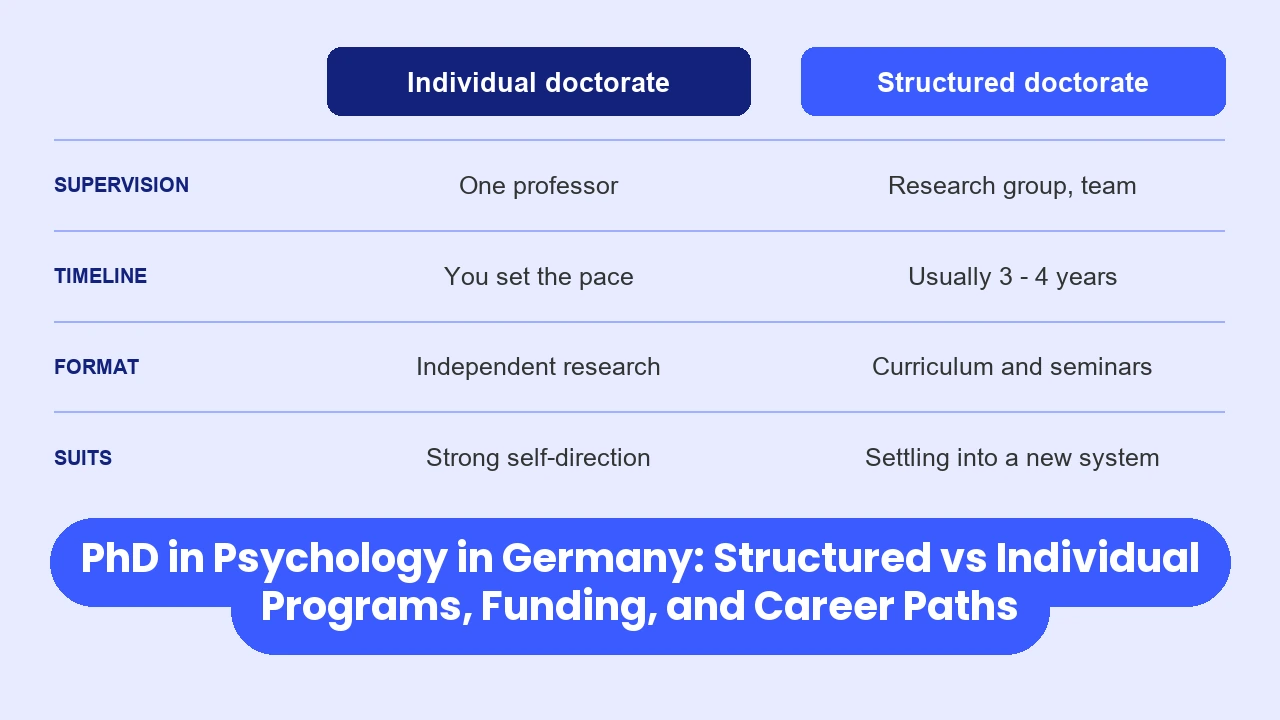
Table of Contents
- Why pursue a psychology PhD in Germany: research infrastructure, stipends, and degree recognition
- Understanding German doctorate terminology: Dr. rer. nat., Dr. phil., and PhD equivalencies
- Structured vs individual doctorate: curriculum, timelines, and supervision models
- Top psychology PhD programs and research schools: Max Planck IMPRS, graduate schools, and university-based tracks
- Eligibility and academic requirements: master’s degree, ECTS credits, and research experience
- Language requirements: English-taught programs vs German proficiency expectations
- Finding a supervisor and crafting a research proposal: traditional doctorate application process
- Funding your psychology PhD: DAAD scholarships, DFG grants, stipends, and employment contracts
- Clinical psychology considerations: research PhD vs psychotherapy training pathways in Germany
- Duration and milestones: typical PhD timelines, publication expectations, and defense process
- Career outcomes after a German psychology PhD: academia, research institutes, and industry paths
- FAQs
- Conclusion
Over 28,000 doctoral degrees are awarded annually in Germany, making it one of Europe’s leading destinations for advanced research. If you’re exploring a PhD in Psychology in Germany, you’re looking at more than just academic prestige. You’re considering a system that combines world-class research facilities, minimal tuition fees, and genuine funding opportunities that can transform your career trajectory. As Ram Srinivasan—CEO at Galvanize and an admissions expert with over 15 years of experience—I’ve seen countless students navigate this path successfully. This guide breaks down everything you need to know: program types, funding sources, application strategies, and career outcomes. Whether you’re drawn to academic research, clinical work, or industry innovation, understanding the German PhD landscape is your first step toward making a strategic, high-return decision.
Table of Contents
- Why pursue a psychology PhD in Germany: research infrastructure, stipends, and degree recognition
- Understanding German doctorate terminology: Dr. rer. nat., Dr. phil., and PhD equivalencies
- Structured vs individual doctorate: curriculum, timelines, and supervision models
- Top psychology PhD programs and research schools: Max Planck IMPRS, graduate schools, and university-based tracks
- Eligibility and academic requirements: master’s degree, ECTS credits, and research experience
- Language requirements: English-taught programs vs German proficiency expectations
- Finding a supervisor and crafting a research proposal: traditional doctorate application process
- Funding your psychology PhD: DAAD scholarships, DFG grants, stipends, and employment contracts
- Clinical psychology considerations: research PhD vs psychotherapy training pathways in Germany
- Duration and milestones: typical PhD timelines, publication expectations, and defense process
- Career outcomes after a German psychology PhD: academia, research institutes, and industry paths
- FAQs
Why pursue a psychology PhD in Germany: research infrastructure, stipends, and degree recognition
Germany stands out as a research powerhouse in Psychology. With over 400 universities and research institutes scattered across the country, doctoral candidates gain access to cutting-edge laboratories, internationally recognized faculty, and collaborative networks that span disciplines.
What makes this particularly attractive? The financial model. Most public universities charge zero tuition fees for doctoral studies. Instead of accumulating debt, PhD candidates typically receive stipends or take salaried positions as research associates. This shifts the economics dramatically compared to other countries, where doctoral students often struggle financially.
German doctorates carry weight globally. Employers and academic institutions across Europe, North America, and Asia recognize these credentials. The country’s strong connections between universities and industry create practical pathways into sectors like health technology, user experience research, and organizational psychology. Post-study work rights add another layer of security, giving graduates time to establish themselves professionally.
Understanding German doctorate terminology: Dr. rer. nat., Dr. phil., and PhD equivalencies
The German system uses specific titles based on your research focus. Understanding these distinctions helps you evaluate programs accurately and communicate your qualifications internationally.
Dr. rer. nat. (Doctor rerum naturalium) is typically awarded for natural sciences, including experimental and cognitive psychology. If your research involves neuroscience, behavioral experiments, or quantitative methods, you’ll likely pursue this designation.
Dr. phil. (Doctor philosophiae) covers the humanities and social sciences. Clinical psychology, developmental studies, and qualitative research often fall under this category.
Both titles are internationally equivalent to a PhD. When applying for positions outside Germany, your degree will be recognized without issue. However, it’s worth checking how your target institution or employer lists the qualification, especially if you’re planning to work in highly regulated fields.
Structured vs individual doctorate: curriculum, timelines, and supervision models
Your experience pursuing a PhD in Psychology in Germany will vary significantly depending on which model you choose.
Individual doctorates follow the traditional German approach. You work independently on your research under a professor’s supervision. This path offers maximum flexibility but demands strong self-direction. You’ll design your study, manage your timeline, and drive your progress with minimal external structure. It works well for students who thrive with autonomy and have clear research questions.
Structured doctorates resemble PhD programs in the US or UK. You join a research group, follow a curriculum, attend regular seminars, and benefit from team supervision. Timelines are more predictable—usually three to four years. You’ll have built-in peer support and clearer milestones.
For international students adjusting to a new academic culture, structured programs often provide a smoother transition. The community aspect reduces isolation, and the formal framework helps you stay on track. That said, individual doctorates can offer deeper immersion in a specific research area if you’ve already established a strong relationship with a supervisor.
Top psychology PhD programs and research schools: Max Planck IMPRS, graduate schools, and university-based tracks
Germany hosts several prestigious institutions specifically designed for doctoral training in psychology.
Max Planck International Max Planck Research Schools (IMPRS) are among the most competitive and well-funded options. They specialize in areas like cognitive neuroscience, developmental psychology, and social cognition. Admission is highly selective, but the resources and mentorship are exceptional.
Graduate schools at universities such as LMU Munich, University of Heidelberg, and University of Leipzig offer structured programs with strong research output. These schools often have partnerships with hospitals, tech companies, and policy organizations, expanding your career options.
Specialized centers like the Berlin School of Mind and Brain focus on interdisciplinary approaches, combining psychology with philosophy, neuroscience, and artificial intelligence.
Explore detailed program listings on DAAD and Study in Germany. For personalized support in identifying programs that match your research interests and career goals, visittalk to a PhD admissions counsellor.
Ready to start your application strategy? Book your consultation with an expert who understands the German admissions landscape and can help you craft a competitive application.
Eligibility and academic requirements: master’s degree, ECTS credits, and research experience
To qualify for doctoral study, you’ll generally need a recognized Master’s degree in psychology or a closely related field. The combined Bachelor’s and Master’s programs should total around 300 ECTS credits.
Your academic record matters. Programs look for strong grades, particularly in research methodology and your area of specialization. Previous research experience—whether through your Master’s thesis, publications, or independent projects—strengthens your application significantly.
Some exceptional candidates with only a Bachelor’s degree may be considered, but this is rare. Most programs expect demonstrated research competence at the Master’s level.
Use uni-assist to get your international credentials evaluated if you’re coming from outside Germany. This service clarifies whether your qualifications meet German standards. For personalized eligibility assessments, consult the Galvanize Master’s admission team.
Language requirements: English-taught programs vs German proficiency expectations
Many doctoral programs, especially structured ones and international research schools, operate entirely in English. Typical requirements include IELTS scores of 6.5 or higher, TOEFL scores above 90, or equivalent certifications.
German proficiency isn’t mandatory for most research-focused PhDs. However, daily life becomes easier with at least basic German skills. If you plan to teach undergraduate courses or conduct field research involving German participants, you’ll likely need B2 to C1 level German.
Clinical pathways have stricter language requirements. Working with patients or pursuing psychotherapy training demands fluent German. Check your target program’s specific language policies early in your planning process.
Finding a supervisor and crafting a research proposal: traditional doctorate application process
For individual doctorates, securing a supervisor (Doktorvater or Doktormutter) comes before formal application. This process requires strategy and persistence.
Start by identifying professors whose research aligns with your interests. University and research group websites provide detailed information about ongoing projects and faculty publications. Read their recent work to understand their approach and priorities.
Reach out with a tailored email that includes your CV and a concise research proposal. Highlight how your interests intersect with their current work. Professors receive numerous inquiries, so clarity and relevance matter.
Your research proposal should be three to five pages, outlining your research question, methodology, theoretical framework, and expected contribution. It doesn’t need to be perfect—supervisors expect refinement—but it should demonstrate serious thought and feasibility.
Structured programs typically have centralized applications, but a strong research statement remains essential. Need guidance on crafting proposals or reaching out to supervisors? Galvanize’s Master’s admission offers expert support in navigating this critical phase.
Funding your psychology PhD: DAAD scholarships, DFG grants, stipends, and employment contracts
Funding availability is one of the strongest arguments for pursuing a PhD in Psychology in Germany. Multiple pathways exist, and many candidates secure full financial support.
DAAD scholarships are prestigious and competitive, covering living expenses and sometimes travel costs. Applications require strong academic records, clear research plans, and compelling motivation letters.
DFG grants fund specific research projects. If your supervisor has DFG funding, you might be hired as a doctoral researcher on their project.
University stipends typically provide between €1,200 and €1,800 monthly. These are tax-free and designed to cover living costs.
Employment contracts are common. Many doctoral candidates work as research associates (Wissenschaftliche Mitarbeiter) on the TV-L pay scale. This provides not only income but also health insurance and pension contributions.
Start your funding search early. Deadlines are strict, and competition is real. A well-prepared application with a clear research direction dramatically improves your chances. For application strategies tailored to competitive funding opportunities, visit Galvanize masters admission.
Clinical psychology considerations: research PhD vs psychotherapy training pathways in Germany
A research doctorate and clinical licensure are separate pathways in Germany. This distinction confuses many international students, so clarity here is crucial.
A PhD in Psychology in Germany is primarily a research qualification. It prepares you for academic careers, research positions, and industry roles. It does not, by itself, qualify you to practice as a psychotherapist.
To work as a licensed psychotherapist, you must complete state-accredited clinical training (Psychotherapeutenausbildung). This training is distinct from doctoral studies, requires fluent German, and involves supervised clinical practice.
If your goal combines research and clinical practice, look for programs that integrate both tracks. These are less common but do exist at certain universities. Alternatively, plan to pursue clinical training after or alongside your PhD.
For purely research-oriented careers in academia, non-profit organizations, or industry, a traditional PhD provides everything you need.
Duration and milestones: typical PhD timelines, publication expectations, and defense process
Plan for three to four years of full-time work to complete your doctorate. The timeline breaks down roughly as follows:
Year one involves literature review, refining your research design, and—in structured programs—completing coursework. You’ll finalize your methodology and begin preliminary data collection.
Years two and three focus on data collection, analysis, and presenting findings at conferences. Many candidates begin drafting papers for publication during this phase.
Year four centers on dissertation writing. Some programs require a traditional monograph; others accept cumulative dissertations (collections of published or submitted articles).
The final milestone is your oral defense (Disputation or Viva). You’ll present your research and respond to questions from an examination committee. This process is rigorous but manageable with proper preparation.
Publishing in peer-reviewed journals is increasingly expected. Programs value candidates who contribute to the broader academic conversation through their work.
Career outcomes after a German psychology PhD: academia, research institutes, and industry paths
Graduates of psychology doctoral programs in Germany enjoy strong career prospects across multiple sectors.
Academic positions remain a primary pathway. Faculty roles at German and other European universities, postdoctoral fellowships, and research scientist positions are common outcomes.
Research institutes such as Max Planck, Fraunhofer, and Helmholtz Centers actively recruit PhD holders. These organizations conduct applied and fundamental research with substantial resources.
Industry roles are growing rapidly. Companies need psychologists for HR analytics, market research, user experience design, health technology development, and organizational consulting.
International careers are accessible. German PhDs carry global recognition. Graduates receive an 18-month post-study work visa to search for employment. Once employed, you can apply for an EU Blue Card and eventually permanent residency.
The combination of rigorous training, international networks, and practical research experience positions graduates competitively in a global job market. For personalized career planning and application support, explore Galvanize masters admission.
FAQs
- What is the main difference between structured and individual PhD programs in Germany?Structured programs provide a set curriculum, group supervision, and a cohort experience—ideal for international students seeking guidance and community. Individual doctorates are mentor-driven and more independent, requiring strong self-motivation and direct supervisor relationships.
- Do I need to know German to do a PhD in Psychology in Germany?Many programs operate in English, especially research-focused tracks. German proficiency is necessary for clinical roles, teaching undergraduate courses, and integrating into daily life, but not always for research work itself.
- Is a German PhD recognized internationally?Yes. Both Dr. rer. nat. and Dr. phil. degrees are internationally equivalent to a PhD and widely recognized in academia and industry worldwide.
- How much does it cost to do a PhD in Psychology in Germany?Most public universities charge no tuition. Living costs range from €900 to €1,200 monthly. Many PhDs are fully funded through stipends or research contracts.
- Can I work during my PhD in Germany?Yes. PhD candidates can work as research assistants or take part-time jobs. Employment contracts often cover living expenses and provide additional benefits.
- What are my chances of getting funding for a psychology PhD in Germany?Funding is competitive but available. Early, well-prepared applications with strong research proposals significantly improve your chances of securing support.
- What is the typical duration of a psychology PhD in Germany?Most PhDs take three to four years full-time. Timelines vary depending on research complexity, supervision quality, and funding arrangements.
- Can I settle in Germany after completing my PhD?Graduates receive an 18-month post-study work visa to find employment. With a job offer, you can apply for an EU Blue Card and eventually permanent residency.
Conclusion
A PhD in Psychology in Germany offers ambitious students a rare combination of academic excellence, financial accessibility, and global career opportunities. By understanding program structures, eligibility requirements, funding mechanisms, and career pathways, you can approach this journey strategically rather than reactively. Success requires clarity about your goals, thorough research into specific programs, and proactive planning around applications and funding.
Whether you’re drawn to cognitive neuroscience, clinical research, or applied psychology in industry settings, Germany’s doctoral landscape provides the infrastructure and support to make your research ambitions tangible. The key is matching your personal strengths and career objectives with the right program type and funding source.
Also useful for Germany applicants:
For personalized guidance through every stage—from selecting programs to crafting compelling applications—trust experts who understand both the German system and international student needs. Book your strategy session with a doctoral admissions guidance today and turn your aspirations into a concrete, achievable plan for a PhD in Psychology in Germany.