PTE vs TOEFL: Format, Scoring, Acceptance, and Fees Explained

Table of Contents
- PTE vs TOEFL Overview: Who Should Take Which Test?
- Eligibility and Basic Requirements
- Exam Pattern and Test Format
- Registration, Test Dates, and Booking in India
- Test Fees, Rescheduling, and Cancellation
- Scoring System and Score Comparison
- Acceptance and Recognition
- Test Day Experience: At-Home vs Test Center
- Results, Score Reports, and Validity
- Prep Plans, Practice Tests, and Choosing the Right Test
Quick Answer: PTE vs TOEFL — which is right for you?
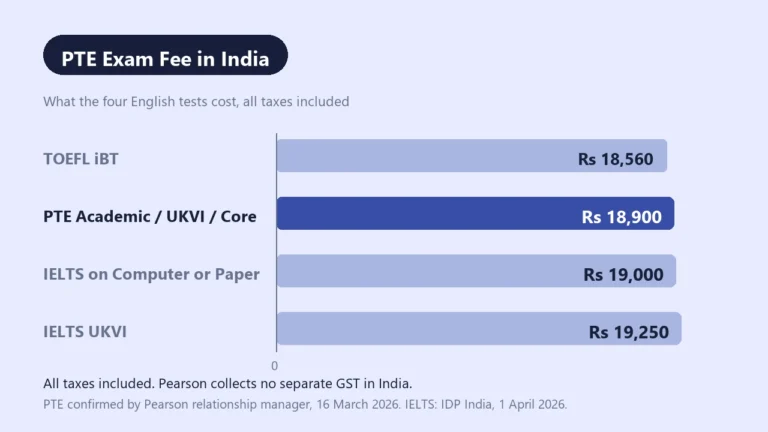
PTE and TOEFL are both widely accepted, but diverge by region: TOEFL dominates in the USA and Canada, while PTE leads in Australia and the UK. TOEFL costs ₹18,560 (as of October 2026, source: ETS) including GST, and PTE ₹18,900 in India (as of October 2026, source: Pearson), inclusive of all taxes (Pearson collects no separate GST). PTE offers faster results (48 hours), while TOEFL takes 6–10 days. Choose based on your target country.
- TOEFL preferred in USA/Canada; PTE in Australia/UK
- TOEFL: 11,500+ institutions; PTE: 3,000+ institutions worldwide
- PTE results in 48 hours; TOEFL in 6–10 days
Over 5 million students worldwide take English proficiency tests each year to pursue their dreams of international education and global careers. Among these, the PTE and TOEFL stand as two of the most recognized assessments, each opening doors to thousands of universities and immigration programs. According to recent data, more than 11,500 institutions accept TOEFL scores, while PTE has gained rapid acceptance across 3,000+ universities, particularly in Australia, the UK, and Canada.
Choosing between these two tests can feel overwhelming, especially when your future depends on making the right decision. The good news? Both tests measure your English language proficiency effectively, but they do so in different ways. Understanding these differences—from test format and scoring to acceptance policies and preparation strategies—will help you select the exam that aligns best with your goals, learning style, and target destination. This comprehensive guide breaks down everything you need to know about PTE vs TOEFL so that you can approach your test choice with clarity and confidence.
Table of Contents
- PTE vs TOEFL Overview: Who Should Take Which Test?
- Eligibility and Basic Requirements
- Exam Pattern and Test Format
- Registration, Test Dates, and Booking in India
- Test Fees, Rescheduling, and Cancellation
- Scoring System and Score Comparison
- Acceptance and Recognition
- Test Day Experience: At-Home vs Test Center
- Results, Score Reports, and Validity
- Prep Plans, Practice Tests, and Choosing the Right Test
PTE vs TOEFL Overview: Who Should Take Which Test?
Your destination country and university requirements should guide your test choice. PTE has become increasingly popular among students targeting Australia, the UK, New Zealand, and Canada, particularly those pursuing permanent residency or work visas. Meanwhile, TOEFL remains the preferred choice for US universities and many institutions across Canada and Europe, with a strong reputation built over decades of academic assessment.
Both tests serve undergraduate students, postgraduate applicants, and MBA aspirants equally well. Working professionals seeking immigration pathways will find acceptance for both exams, though PTE often provides more flexible testing dates and quicker results. Before making your decision, always verify your specific university or visa program requirements, as some institutions may have preferences that influence which test works best for your application timeline.
Eligibility and Basic Requirements
Both tests have straightforward eligibility criteria. You must be at least 16 years old to register, with parental consent required for test-takers under 18. A valid, non-expired passport serves as your identification document for both exams. There are no official limits on how many times you can attempt either test, though PTE requires a 5-day waiting period between attempts while TOEFL needs only 3 days.
Registration begins by creating an account on each test’s official portal. Make sure your passport information matches exactly what you enter during registration, as discrepancies can cause problems on test day.
Exam Pattern and Test Format
The format differences between PTE and TOEFL often determine which test feels more natural for different learners. PTE integrates skills within sections—you might speak while reading a passage or summarize spoken text—creating a dynamic, fast-paced testing experience. The entire exam takes about 2 hours and combines Speaking and Writing into one 54-67 minute section, followed by separate Reading (29-30 minutes) and Listening (30-43 minutes) sections.
TOEFL takes a more traditional academic approach, with distinct sections for each skill. You’ll complete Reading (35 minutes), Listening (36 minutes), Speaking (16 minutes), and Writing (29 minutes) separately, for a total test time of 1 hour and 56 minutes. The passages and lectures mirror what you’d encounter in university settings, making TOEFL particularly effective for students who prefer structured, academic-style tasks and want preparation that directly reflects classroom experiences.
Registration, Test Dates, and Booking in India
Booking your test is entirely online for both options. PTE registration happens through the Pearson PTE website, where you’ll find test centers in over 50 Indian cities with dates available almost daily. TOEFL registration uses the ETS portal, offering widespread test center availability across India. Both exams now provide at-home testing options, adding flexibility to your scheduling.
Plan to register at least 2-3 months before your university application deadline to ensure score delivery aligns with submission requirements. You’ll need a valid passport and a credit or debit card for payment.
Test Fees, Rescheduling, and Cancellation
Test costs in India are comparable for both exams. PTE fees stand at ₹18,900 (as of October 2026, source: Pearson), inclusive of all taxes (Pearson collects no separate GST), while TOEFL costs ₹18,560 (as of October 2026, source: ETS) including GST. Both allow rescheduling if done at least 14 days before your test date, though fees apply. Cancellation policies provide partial refunds when done 14 or more days in advance.
Fee structures can change, so always check the official Pearson PTE or ETS TOEFL websites for current pricing and policy details before booking.
Scoring System and Score Comparison
PTE uses a 10-90 scoring scale and relies on computer-based grading for objective, consistent results delivered within 48 hours. TOEFL scores range from 0-120, with each of the four sections worth 30 points. Results typically arrive in 4-6 days.
Understanding score equivalencies helps when universities accept multiple tests. A PTE score of 65 roughly equals TOEFL 89-93 or IELTS 7.0. PTE 79 corresponds to TOEFL 100-105 or IELTS 7.5, while PTE 59 matches TOEFL 78-82 or IELTS 6.5. Many universities provide detailed score requirements on their admissions pages, and official concordance tables from both testing organizations offer precise conversions.
Acceptance and Recognition
Both tests carry global recognition, though their acceptance patterns differ. TOEFL’s extensive network spans 11,500+ institutions across 160+ countries, with particularly strong representation among US and Canadian universities. This broader acceptance, combined with decades of academic trust, makes TOEFL the preferred choice for students targeting North American institutions or seeking the widest possible university options.
PTE has secured acceptance at 3,000+ universities, with strong representation in Australia, the UK, Canada, and New Zealand. All Australian and UK visa authorities accept PTE scores, making it valuable for immigration pathways.
For visa and immigration purposes, both tests work for Australian, UK, and Canadian permanent residency applications. Always confirm acceptance with your specific immigration authority or university admissions office, as requirements can vary by program and year.
Test Day Experience: At-Home vs Test Center
Test centers for both exams maintain strict security protocols, including biometric verification and identification checks. The controlled environment ensures fair testing conditions, though some students find it stressful.
At-home options have expanded access significantly. PTE uses AI proctoring for online tests, while TOEFL offers the TOEFL iBT Home Edition with live remote proctoring. However, not all universities accept at-home test results, so verification before choosing this option is essential. Some students prefer the comfort of home testing, while others value the distraction-free environment of test centers.
Results, Score Reports, and Validity
Score delivery speed differs notably between the two tests. PTE delivers results in 24-48 hours and allows unlimited free score sends to institutions. TOEFL results arrive in 4-6 days, with the first four score reports included free and additional reports costing $29 each (as of October 2026, source: ETS).
Both tests maintain score validity for two years from the test date. Access your PTE results through the Pearson results portal, while TOEFL scores appear in your ETS account. Plan to take your test with enough time for scores to reach universities before application deadlines, accounting for processing time at receiving institutions.
Prep Plans, Practice Tests, and Choosing the Right Test
try a free full-length TOEFL mock test before you commit.
Effective preparation separates achieving scores from reaching your target scores. PTE preparation should focus on integrated tasks—speaking while reading passages, summarizing spoken text, and handling multiple skills simultaneously. The fast-paced format rewards those who can think quickly and manage time efficiently.
TOEFL preparation emphasizes academic skills like essay writing, lecture comprehension, and detailed note-taking. Students preparing for TOEFL benefit from resources designed for academic success. For comprehensive preparation, the TOEFL mock test provides realistic practice conditions, while dedicated TOEFL preparation resources at offer structured learning paths designed for score improvement.
Your test choice depends on personal factors. If you thrive with integrated, fast-paced tasks and want quick results, PTE may suit you well. However, if you’re targeting US or Canadian universities, prefer traditional academic task formats, or want the broader institutional acceptance that comes with TOEFL’s established reputation, TOEFL often represents the better strategic choice.
Ready to put this into practice?
Take a free full-length TOEFL mock test — realistic format with an instant score report. Start your free TOEFL mock test →
Frequently Asked Questions
Which is easier, PTE or TOEFL?
Test difficulty varies by individual learning style. Many students find PTE easier due to integrated tasks and computer-based scoring. However, those comfortable with academic reading and structured writing often prefer TOEFL’s format.
How often can I retake these tests?
PTE allows retakes every 5 days, while TOEFL permits retesting every 3 days. Neither test imposes official attempt limits.
Which test works better for Australia PR?
Both tests are accepted for Australian permanent residency. PTE is sometimes preferred for its faster results and flexible scheduling.
Are at-home test results universally accepted?
Not always. While many institutions accept online test results, some require test center scores. Always verify with your target university or immigration program.
How quickly will I receive my scores?
PTE results typically arrive within 48 hours. TOEFL results take 4-6 days.
Can I send scores to multiple universities for free?
PTE allows unlimited free score sends. TOEFL includes four free score reports, with additional reports costing $20 each.
Conclusion
Selecting between PTE and TOEFL represents more than just choosing a test—it’s about aligning your assessment with your academic goals, immigration plans, and personal learning style. Both exams have earned their place as trusted measures of English proficiency, opening doors to universities, career opportunities, and new lives across the globe. The key lies in understanding what each test offers and how those features match your specific needs. Consider your target destination carefully, research your university’s preferences, and honestly assess which format plays to your strengths. PTE offers speed and flexibility, particularly valuable for immigration pathways and tight deadlines.
TOEFL provides broader acceptance and an academic focus that mirrors university expectations, making it ideal for students prioritizing North American institutions or seeking maximum application flexibility. Whichever path you choose, success ultimately depends on structured preparation, consistent practice, and confidence in your abilities. The right test, combined with dedicated study and strategic preparation, will help you demonstrate your English proficiency effectively and move confidently toward your goals. Your journey to international education or immigration starts with this decision, but it continues with the effort you invest in preparation and the determination you bring to test day.