Study in Japan: What Every International Student Should Know Before Applying


Key Takeaways
- Japan hosted 408,069 international students as of 1 May 2025 (JASSO), with hundreds of English-taught degrees now available.
- Public-university fees are published and predictable: about ¥282,000 admission fee once, and around ¥535,800 tuition a year.
- The Certificate of Eligibility drives the visa timeline and takes one to three months — everything else plans around it.
- Part-time work is capped at 28 hours a week in term and eight hours a day in long holidays, and needs a separate permission first.
- Start in a university dormitory at ¥20,000–¥50,000 a month; private rentals add key money and a deposit of one to three months' rent each.
Table of Contents
- Why choose Japan over other study-abroad destinations?
- Which universities take international students?
- How does the education system work?
- What language scores do you need?
- How do the student visa and Certificate of Eligibility work?
- What does MEXT cover, and how do you apply?
- What does it really cost?
- Which English-taught degrees are available?
- What are the part-time work rules?
- What is campus life actually like?
- How do you find accommodation?
- Conclusion and next steps
Japan hosted 408,069 international students as of 1 May 2025, according to JASSO’s International Student Survey, and the country continues to position itself as a major global hub for higher education. For many Indian families the prospect still feels exciting but opaque: an unfamiliar language, different scripts, and an admissions and visa system that works differently from the one they know.
This guide covers how studying in Japan works in practice — what it costs, what MEXT and JASSO actually cover, the language scores you need, how the student visa and Certificate of Eligibility process runs, and what daily life on campus looks like. If you want the wider destination overview first, start with our study in Japan hub.
Why choose Japan over other study-abroad destinations?
Japan works as an alternative to the US or UK because it combines lower public-university tuition, substantial scholarships, serious research and a settled, well-organised student environment. For engineering, computer science and related fields, MEXT or JASSO funding plus post-study work options make it more sustainable than several Western destinations.
- Highly ranked universities including the University of Tokyo, Kyoto University, Osaka University and Tohoku University.
- Industry connections with Toyota, Sony, Hitachi and Rakuten that reach into teaching and research.
- A defined path from MEXT-funded study through to work and Highly Skilled Professional status after graduation.
For motivated STEM and management students the return is strong, provided the language learning and scholarship strategy start early rather than in the final year. Our complete guide to studying in Japan covers the wider decision; this piece focuses on what to settle before you apply.
Which universities take international students?
Top Japanese universities recruit internationally through English-taught and mixed-language programs at undergraduate, master’s and PhD level. You can apply to national, public (prefectural or municipal) and private universities depending on budget and academic goals.
- University of Tokyo — PEAK (Programs in English at Komaba): a BA in Environmental Sciences and an International Program on Japan in East Asia.
- Kyoto University — international graduate programs in engineering, informatics and life sciences.
- Osaka University — English tracks in engineering science and information science.
- Tohoku University — IMAC-U in mechanical and aerospace engineering, applied chemistry, and electrical and communication engineering.
- Waseda University — SILS, plus English-track computer science and engineering.
- Keio University — PEARL in economics, and GIGA in policy management and environment and information studies.
- Sophia University — the Faculty of Liberal Arts and global studies programs.
Many belong to Japan’s Top Global University Project, the government initiative to internationalise campuses. For authoritative program listings use JPSS and the official Study in Japan portal, and see our comparison of national versus private universities in Japan before fixing a shortlist.
How does the education system work?
The structure is straightforward once mapped: undergraduate (gakubu) runs four years, or six for medicine, dentistry and veterinary science; a master’s (shūshi) two years; a doctorate three to four.
- National universities — relatively low tuition and a strong research focus.
- Public universities (prefectural or municipal) — moderate tuition.
- Private universities — higher tuition, and generally more English-taught options.
Three entry pathways exist: English-taught degree programs that need no Japanese at entry; Japanese-medium programs, which usually expect JLPT N2 or N1 before admission; and research student (kenkyūsei) status, which can lead into formal enrolment on a master’s or PhD.
What language scores do you need?
You can begin without Japanese if you choose a fully English-taught program. Japanese still becomes essential for internships, part-time work and full-time jobs, so treat it as a skill to build steadily rather than a box to tick.
- English-taught programs: Japanese is often not required at admission. English is, commonly IELTS 6.0–7.0 or TOEFL iBT 80–100 at competitive universities.
- Japanese-medium programs: JLPT N2 or N1, particularly in humanities, law and medicine. Some universities also weigh EJU scores.
A workable plan is N5–N4 before arrival for daily life, then N3–N2 during the degree to open up part-time work and job hunting.
How do the student visa and Certificate of Eligibility work?
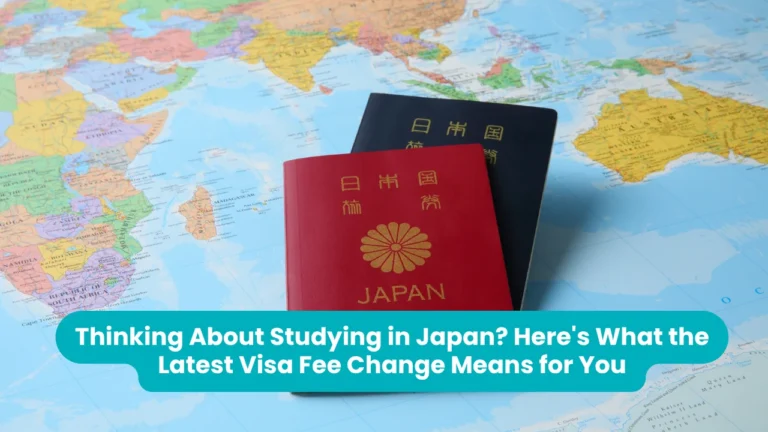
Long-term study requires a Student (ryūgaku) visa, issued on the basis of a Certificate of Eligibility approved in Japan. In most cases the admitting university or language school applies for the CoE on your behalf.
- Receive an official admission offer.
- Submit CoE documents to the institution — passport copy, financial proof such as bank statements and sponsor letters, academic transcripts and certificates, and the required forms.
- The institution files with the Immigration Services Agency of Japan.
- The CoE is issued, generally in one to three months depending on volume and timing.
- Submit the CoE, visa application form, photographs and passport to the Japanese embassy or consulate in India.
- The visa is typically processed within a couple of weeks.
Once in Japan you apply separately for permission to work part-time. The full sequence is in our step-by-step guide to the Japan student visa process; always confirm current requirements on the embassy site and the Study in Japan portal.
What does MEXT cover, and how do you apply?
MEXT is Japan’s flagship government scholarship and can make study here close to cost-free for selected students: a full tuition waiver at the host university, a monthly stipend, and round-trip economy airfare. Study in Japan lists monthly amounts from ¥117,000 for some categories up to ¥143,000–¥145,000 for research students, with variation by program and year.
- Embassy-recommended: apply through the Japanese embassy or consulate, typically with written exams and interviews.
- University-recommended: apply through the university, usually for research or graduate programs tied to a specific research theme.
Competition is intense, so strong academics, a well-structured research plan at graduate level and a clear, specific reason for choosing Japan all matter. Structured admissions guidance helps most on the research plan, which is where applications usually lose their edge.
What does it really cost?
At a public university the standard published amounts are an admission fee of approximately ¥282,000, paid once, and tuition of around ¥535,800 per year — roughly ¥817,800 in the first year and ¥535,800 thereafter. Yokohama National University publishes exactly those figures.
Monthly living costs for a single student run in the region of ¥90,000–¥120,000 in Tokyo and Yokohama, ¥80,000–¥110,000 in Osaka and Kyoto, and ¥70,000–¥100,000 in Sendai and Fukuoka. Our city-by-city breakdown of living costs in Japan goes further into where the differences actually come from.
Three things offset the total: part-time work within the legal limits, JASSO support — JASSO lists the Monbukagakusho Honors Scholarship at ¥48,000 per month — and university tuition reductions, which at some institutions reach a full waiver.
Which English-taught degrees are available?
There are now hundreds of English-taught programs, concentrated at universities in the Top Global University Project, so you can complete a full degree in English while building Japanese through campus language courses.
- Undergraduate: UTokyo PEAK, Waseda SILS, Keio PEARL, Keio GIGA and Sophia FLA.
- Master’s and PhD: engineering, computer science, AI and robotics at Tohoku University, Osaka University, the Institute of Science Tokyo and Nagoya University.
- Business and policy: Hitotsubashi ICS, Waseda Business School and the International University of Japan.
These lower the initial language barrier without limiting long-term prospects — provided you use the time to build Japanese rather than avoid it.
What are the part-time work rules?
Study in Japan sets the limits: within 28 hours per week during the academic term, and up to eight hours per day during long school holidays. You must first obtain permission to engage in an activity other than that permitted under your status of residence (shikakugai katsudō kyoka), available at the airport on arrival or at a regional immigration office.
Common work is convenience stores, restaurants and cafes, English teaching or assistant roles, and research assistantships for graduate students. Hourly pay tracks regional minimum wages and is highest in the big cities. Do not exceed the limits — a serious violation puts your visa status, and therefore your degree, at risk. Our guide to part-time jobs in Japan covers what students most often get wrong.
What is campus life actually like?
Campus life is structured and community-oriented, and the biggest adjustment is usually communication style rather than anything else.
- Keigo. Polite language is standard in offices and formal settings; a few phrases carry you a long way at first.
- Senpai–kōhai. Senior-junior relationships matter, and seniors genuinely mentor juniors in clubs and labs.
- Group-first norms. Punctuality, preparation and reliability count for more than visible self-promotion.
Clubs and circles cover sport, music, anime, robotics and much else, and are the fastest route into a social circle. International offices run orientation, counselling and Japanese classes. City character varies: Tokyo is fast and dense with a large Indian community, Osaka is friendlier and food-obsessed, Kyoto is traditional and academic, Sendai is greener, student-centric and cheaper.
How do you find accommodation?
Housing is the first practical challenge, and the process differs from India in ways worth knowing before you arrive.
- University dormitories — commonly ¥20,000–¥50,000 a month, and often prioritised for new international students.
- Private apartments — roughly ¥40,000–¥80,000 and upwards, depending on city, size and distance from campus.
- Share houses and guesthouses — sociable, and utilities are often included in the rent.
For private rentals, budget for key money and a deposit of around one to three months’ rent each, though student-focused agencies sometimes reduce or waive them. Rooms are compact by Indian standards — 15–25 m² is normal in student neighbourhoods. The practical strategy is to start in a dormitory and move once you understand the area and the rental system.
Conclusion and next steps
Japan is not a black box. Once the system is mapped, studying here becomes a sequence of manageable decisions: English-taught or Japanese-medium, which universities, how to plan MEXT and JASSO, what the visa and work rules allow, and how to build the language steadily. What it needs is an early start and a realistic timeline.
For Indian students the combination is genuinely rare — strong universities, affordable public tuition, deep STEM and business ecosystems, and scholarships that can carry most of the cost. If you want help turning that into a plan, from university lists to MEXT strategy, talk to our admissions counselling team.
Frequently Asked Questions
Can I study in Japan without knowing Japanese?
Yes. Many Top Global Universities run complete degrees in English — UTokyo PEAK, Waseda SILS, Keio PEARL and Sophia FLA among them — and you learn Japanese alongside. Building proficiency during the degree is still strongly advised for internships, part-time work and careers afterwards.
How much Japanese should I know before arriving?
For English-taught programs, JLPT certification is usually not required at admission. Aiming for N5–N4 before departure makes daily life much easier, and N3–N2 over two to three years opens up better work and clearer communication with professors and employers.
Is Japan cheaper than the US or UK?
For a public university, generally yes. Published tuition at a national university is around ¥535,800 a year, well below typical international tuition in the UK or US for comparable programs. Living costs are comparable to major European cities, and MEXT, JASSO or university scholarships reduce the total further.
How competitive is MEXT for Indian students?
Highly competitive, but achievable with strong academics and a clear study or research plan. Indian students receive MEXT awards at undergraduate, master’s and PhD level every year. What separates successful applicants is usually a focused, realistic research proposal and confident interview performance.
Can I work in Japan after I graduate?
Yes. Graduates commonly move from Student status to Engineer / Specialist in Humanities / International Services, or to the points-based Highly Skilled Professional visa. A technical or business degree, Japanese around N3–N2 or better, and some internship experience make that a realistic path.
Are there good MBA or business options?
Yes — Hitotsubashi ICS, Waseda Business School and the International University of Japan all offer English-taught programs with internships, corporate projects and strong networks. For a mid-career applicant they work as a bridge into Japan’s corporate ecosystem and regional roles across Asia.
How many hours can a student work part-time?
With permission, up to 28 hours per week during the academic term and up to eight hours per day during long school holidays. Track your total hours across every job you hold — exceeding the limit is a serious immigration violation, not a technicality.
Is it safe for Indian students to live in Japan?
Japan has low reported crime, reliable public transport and secure campuses, and most students live independently without difficulty. Normal precautions still apply, particularly in nightlife districts, and universities run orientation covering earthquake and typhoon procedures.
Which exams do English-taught programs require?
IELTS or TOEFL alongside your academic transcripts, in most cases. Some universities also ask for SAT, ACT or AP results for undergraduate admission, and graduate applicants in competitive STEM tracks are occasionally asked for the GRE. Check the specific program page rather than assuming.