MS or PhD? The Wrong Choice Can Change the Direction of Your Career

Key Takeaways
- A doctorate is a different activity, not a longer master's — four to six years on open problems where nobody, including your supervisor, knows the answer.
- The real cost question is not money but time. A funded PhD can cost nothing in fees while costing four to six years of salary and seniority; a self-funded MS inverts that.
- Funding lives with faculty and their grants, not with the admissions office. Target supervisors with active funding, not universities with famous names.
- Insufficient research experience is the most common reason strong candidates are rejected. Grades alone are not evidence you can work independently on an open problem.
- If you are genuinely uncertain, a research master's is the instrument — one to two years, real research experience, and it stands as a complete qualification if you decide against a PhD.
Table of Contents
- MS or PhD: how does the wrong choice change your career direction?
- What is the real difference between an MS and a PhD in outcomes?
- How long does each path take and what does it cost?
- How does PhD funding work compared with a self-funded MS?
- What research experience do you need before applying for a PhD?
- Research master’s versus PhD: what is the difference?
- Can you convert from an MS to a PhD after starting?
- Which countries offer the best funded PhD opportunities?
- How do industry careers differ for MS and PhD graduates?
- How do you find and approach a potential PhD supervisor?
- What are the signs you are not ready for a PhD yet?
- What should you do in the next 30 days?
- The bottom line
I completed a PhD in mechanical engineering at the University of Tennessee, Knoxville, so I can tell you something the brochures will not: a doctorate is not a longer master’s. It is a different activity with a different daily reality, a different funding model and a different relationship with the person supervising you — and that last factor decides more outcomes than the university’s name ever will.
The decision between them is the one I take most seriously in my work at Galvanize, because it is the least reversible. A master’s that turns out to be wrong costs you eighteen months. A doctorate that turns out to be wrong can cost you four or five years at the point in your life when those years compound hardest.
MS or PhD: how does the wrong choice change your career direction?
Choosing wrongly costs you years rather than months, because a PhD is a four-to-six-year commitment whose value is concentrated in research and academic careers. An MS taken when you needed a PhD limits your access to research-intensive roles; a PhD taken when you needed an MS delays your industry entry by several years for a credential many employers do not require.
The asymmetry matters. The second error is more expensive than the first, and it is also the more common one among students who are academically strong but uncertain about direction.
What is the real difference between an MS and a PhD in outcomes?
An MS trains you to apply existing knowledge at an advanced level. A PhD trains you to produce new knowledge, and the qualification certifies that you have done so independently.
That distinction sounds abstract until you examine the daily work. A master’s student takes structured courses with defined syllabi, assessed deliverables and known answers. A doctoral student spends most of their time on an open problem where nobody — including the supervisor — knows the answer, and where the skills being developed are persistence, self-direction and tolerance for extended uncertainty.
Some people find that genuinely liberating. Others find it corrosive. Neither reaction reflects intelligence, and knowing which category you fall into is worth considerably more than any admission statistic.
On outcomes specifically: industry research roles, research and development leadership, and academic positions typically require or strongly prefer a doctorate. Most other roles, including the great majority of well-paid technical positions, do not.
How long does each path take and what does it cost?
| Factor | MS | PhD |
|---|---|---|
| Typical duration | One to two years | Four to six years |
| Funding model | Usually self-funded; some assistantships | Commonly funded with a stipend |
| Indicative net cost | ₹12–70 lakh depending on destination | Often near zero if funded |
| Forgone earnings | One to two years | Four to six years |
| Primary output | Coursework, project or thesis | Original research, publications, dissertation |
| Decisive relationship | Programme and department | The individual supervisor |
These rupee figures are planning ranges rather than published rates. Verify against EducationUSA for the USA and the relevant national portal for other destinations.
The line that reframes the entire comparison is forgone earnings. A funded PhD may cost you nothing in fees while costing you four to six years of professional salary and seniority. A self-funded MS costs considerably in fees and very little in time.
The honest framing is not which is more expensive. It is: are you paying in money, or in years?
How does PhD funding work compared with a self-funded MS?
This is the structural fact that surprises most Indian applicants. In the USA and much of Europe, doctoral study is commonly funded — a tuition waiver plus a stipend, in exchange for teaching or research assistance, or through a research grant or fellowship.
A funded PhD abroad is therefore economically closer to a modestly paid job than to a purchase. The stipend is not generous, but it covers living costs, and you emerge without debt.
Compare that with a self-funded master’s carrying substantial fees and no stipend, and the naive cost comparison inverts entirely. The PhD is cheaper in cash and far more expensive in time.
Where does the funding come from? Departments with active research grants, supervisors with funded projects, and institutional fellowships. That is precisely why I tell doctoral applicants to target supervisors rather than universities — funding lives with faculty and their grants, not with the admissions office.
What research experience do you need before applying for a PhD?
Meaningfully more than most applicants assume, and insufficient research experience is the most common reason strong candidates are rejected.
What genuinely counts: a substantial undergraduate or master’s thesis, a publication or conference paper, a research internship, or sustained project work with a faculty member who can speak specifically to your independence and capability. What does not count: strong grades alone, coursework projects, or general enthusiasm for the field.
The reason is straightforward. A supervisor taking you on is committing years of their funding and sustained attention. They are assessing whether you can work independently on an open problem — and the only meaningful evidence for that is having done something like it before. Our guide to the research statement of purpose covers how to present that evidence once you have it.
If you lack that evidence, the most efficient route is a research-oriented master’s first. Which brings us to a distinction worth drawing carefully.
Research master’s versus PhD: what is the difference?
A research master’s — a thesis-based degree of one to two years — gives you a real research experience at a fraction of the time commitment. You find out whether you genuinely enjoy working on open-ended problems before committing five years to them.
For an uncertain applicant this is close to the ideal instrument. It produces evidence for a future doctoral application, it stands as a complete qualification in its own right if you decide against a PhD, and in Germany, the Netherlands and Japan it can be pursued at very low total cost.
I recommend this route regularly, and the students who take it consistently make better doctoral decisions than those who proceed directly without the intermediate experience.
Can you convert from an MS to a PhD after starting?
In the American system, frequently yes. Many departments admit students to a master’s and allow transition into the doctoral track based on performance and supervisor agreement, and some admit directly to a PhD with a master’s awarded along the way. Our guide to doing a PhD in the USA sets out how those pathways are structured.
In European systems this is less standard, since doctoral admission is typically a separate process tied to a specific funded project or individual supervisor opening.
If flexibility matters to your planning, the American structure offers considerably more of it. Ask the department directly about transition pathways before enrolling rather than assuming they exist.
Which countries offer the best funded PhD opportunities?
The USA has the largest volume of funded doctoral positions, with assistantship and fellowship structures well established across research universities.
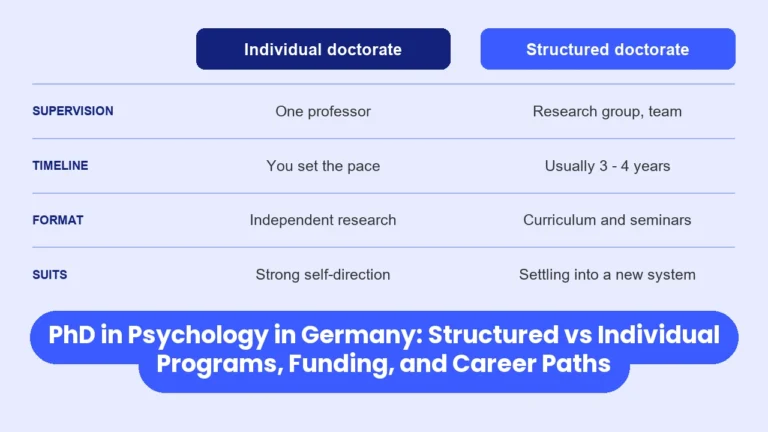
Germany offers doctoral positions frequently structured as employment contracts on active research projects, with a salary rather than a stipend — our guide to a PhD in Germany covers how those posts are advertised and filled.
Japan offers funded routes through MEXT scholarships across embassy-recommended and university-recommended tracks, with additional support through JASSO. It is consistently underused by Indian applicants relative to what it genuinely offers; see our guide to a PhD in Japan.
The Netherlands treats doctoral candidates as employees at many institutions, with full salary and employment benefits. Australia offers funded positions through research training schemes.
The strategic point is that funding availability varies more by department and supervisor than by country. A well-funded lab at a mid-ranked university is a better doctoral home than an unfunded position at a famous one.
How do industry careers differ for MS and PhD graduates?
PhD graduates enter industry at research and senior technical levels — in research and development functions and in specialised areas such as quantitative finance, drug discovery, machine learning research and semiconductor design — where the doctorate is a genuine requirement rather than a preference.
MS graduates enter at engineering and analyst levels with faster progression into management. After five years the salary gap between an MS holder with five years of professional experience and a fresh PhD is often smaller than expected, because the MS holder has been earning and being promoted throughout.
The doctorate pays off over a longer time horizon and in specific functions. If your target role does not require one, those years are usually better invested in working.
How do you find and approach a potential PhD supervisor?
This is the highest-leverage activity in a doctoral application, and most applicants do it badly. Follow this sequence.
- Read recent papers in your area and note who is publishing work you find genuinely interesting rather than merely impressive.
- Check funding status carefully — look for active grants, recent doctoral hires and lab pages listing openings.
- Write specifically, referencing a particular paper, explaining what you would want to build on, and attaching a short focused CV.
- Propose something small. A paragraph of research direction demonstrates independent thought far better than a paragraph of admiration.
- Expect a low response rate. Contact fifteen potential supervisors; hearing meaningfully from three is a good outcome.
Our guide to approaching PhD supervisors works through the email itself in more detail.
The supervisor relationship will determine your doctoral experience more than any other single factor. Choose it as deliberately as you would choose an employer, because for four to six years that is precisely what it is.
What are the signs you are not ready for a PhD yet?
- You have no independent research experience of any kind
- You can name a discipline but not a specific research area or open question
- You are drawn to the title rather than the daily work it requires
- You are considering it because the current job market feels difficult
- You have never read a complete research paper in your intended area and found its questions genuinely interesting
- You need certainty and clear structure to work productively
None of these are permanent conditions. A research master’s addresses most of them within two years, and does so with evidence rather than conjecture.
What should you do in the next 30 days?
- Week 1 — Read five recent papers in your area of interest and note honestly whether you find the open questions energising or exhausting.
- Week 2 — Audit your research evidence against what doctoral programmes actually require. If it is thin, plan a research master’s rather than a doctoral application.
- Week 3 — Identify fifteen potential supervisors with active funding in your target area, and draft specific, referenced enquiries.
- Week 4 — Model both paths including forgone earnings across five years, and get your profile assessed against research programme entry requirements.
If you are still building the wider calendar, our complete fall 2027 application roadmap shows where supervisor outreach sits against everything else.
The bottom line
Whether to do a PhD is a question about the work rather than the credential. If open-ended problems energise you and your target roles require original research, a funded doctorate is one of the few postgraduate paths that costs little in cash. If you are drawn to the qualification but not to the daily reality of producing new knowledge, the years will feel very long.
The instrument for resolving genuine uncertainty is a research master’s, not a leap of faith. It is shorter, cheaper, and it produces exactly the evidence a strong doctoral application needs. The students who resolve this question through evidence rather than through optimism about their own future certainty consistently make better decisions and have better doctoral experiences.
If you want your research profile honestly assessed and a supervisor-targeting strategy built for your specific area, start with a free master’s profile review, or work through the full application sequence with master’s and research admission counselling. Undergraduate students planning a research career should begin with bachelor’s admission counselling.
Frequently Asked Questions
Should I do a PhD or a master's?
A master’s if you want advanced applied expertise and industry entry within two years. A PhD if you want to produce original research and your target roles genuinely require that credential.
Is a PhD abroad funded?
Commonly yes, through assistantships, fellowships or employment contracts, particularly in the USA, Germany, the Netherlands and Japan. Funding lives with departments and supervisors rather than with central admissions offices.
How long does a PhD take?
Typically four to six years depending on country and field, which represents the highest single cost of the decision when measured in forgone earnings rather than fees.
Do I need a master's before a PhD?
In the USA, often not — direct-entry doctoral admission from a bachelor’s degree is standard at many research universities. In much of Europe, a master’s is usually expected first.
How much research experience do I need to apply?
Meaningful independent work: a substantial thesis, a publication, or a research internship where you worked on open questions. Strong grades alone are rarely sufficient evidence.
Can I switch from an MS to a PhD midway?
Frequently in the American system, where transition pathways are common within departments. Less so in Europe, where doctoral admission is tied to specific funded project openings.
Which country is best for a funded PhD?
The USA for volume of positions, Germany and the Netherlands for salaried employment contracts, Japan for MEXT-funded routes. Departmental funding capacity matters more than national averages.
Is a PhD worth it financially?
Over a long horizon and in research-specific roles, yes. If your target role does not require a doctorate, the four to six years are usually better invested in professional experience.
How do I find a PhD supervisor?
Read recent papers, identify authors with active grant funding, and write specific emails referencing their work with a short proposed research direction. Expect and plan for a low response rate.
What if I am unsure about committing to a PhD?
Take a research master’s first. It gives you genuine independent research experience, produces the evidence a later doctoral application needs, and stands as a complete qualification on its own.