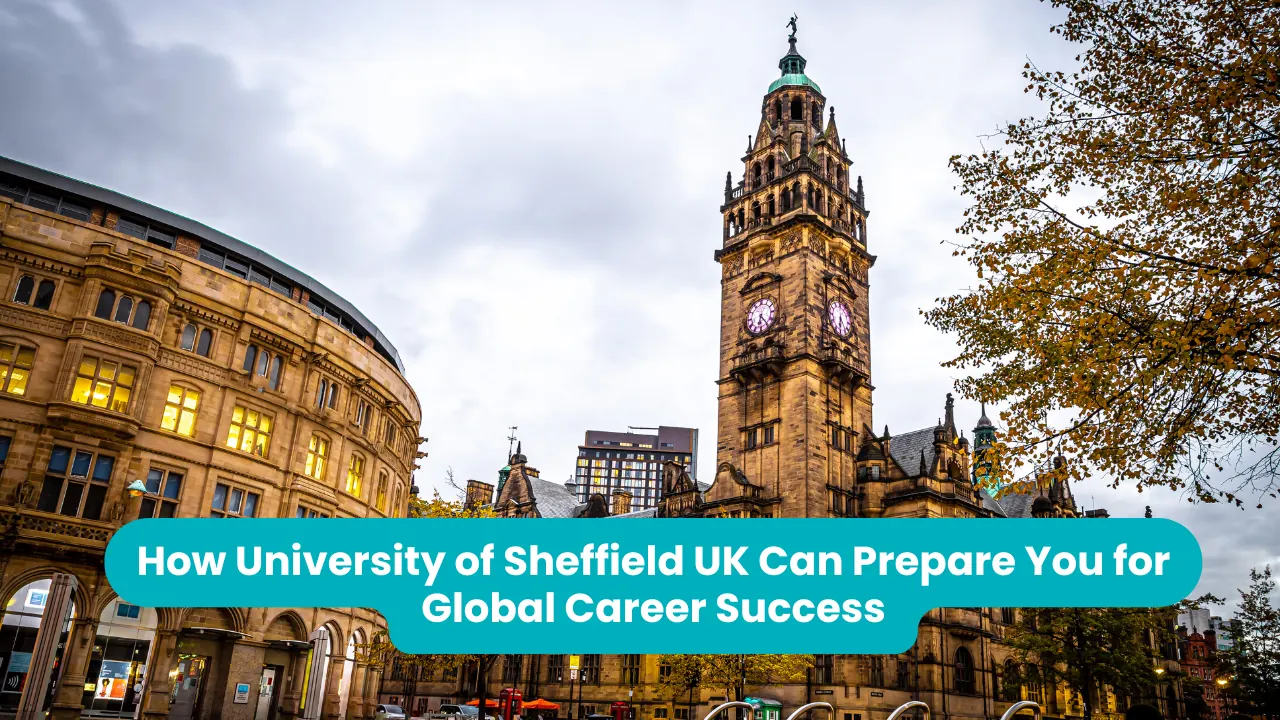
How University of Sheffield UK Can Prepare You for Global Career Success

Key Takeaways
- The Graduate Route is being cut. GOV.UK states a Graduate visa lasts 2 years if you apply on or before 31 December 2026 and 18 months if you apply on or after 1 January 2027, with 3 years for doctoral graduates. Career preparation is now a first-term activity.
- The placement year is the strongest thing on offer and its terms are explicit: penultimate year, usually at least 38 weeks, self-sourced with school and careers-service support, paid in most instances, open to home and international students, and named in your award title.
- Sheffield records 82nd in the world and 14th in the UK in QS 2027, 108th in the world and 12th in the UK in THE 2026, and 92 per cent of research and impact assessed as world-leading or internationally excellent in the last REF.
- The Advanced Manufacturing Research Centre is an employer cluster rather than a brochure line, which is what makes Sheffield genuinely relevant for aerospace, materials, automation and industrial innovation.
- The International Undergraduate Scholarship for September 2026 is £2,500 a year, up to £10,000 over four years, for self-funded overseas students holding a 60% weighted mean grade, with Sheffield as firm or insurance choice by 3 June 2026.
Table of Contents
- What has changed about staying on after the degree?
- What does the careers service actually provide?
- How does the placement year work, and who can take it?
- Which industries actually recruit Sheffield graduates?
- What does a postgraduate course cost?
- What scholarships are on offer?
- Where does Sheffield rank, and what does that buy?
- How much does the alumni network help?
- Is Sheffield the right choice for you?
Most university guides talk about employability as though it were a property of the institution. It is not. It is a property of what you do in the first ten weeks, against a clock that has just been shortened.
Sheffield is a useful case because it publishes more of the machinery than most: a placement year with stated terms, a research centre that is genuinely an employer cluster, and an alumni network large enough to be worth working. What follows is what that machinery does, what it costs, and where it stops and you start.
One clarification first, because it costs applicants offers: this is the University of Sheffield, not Sheffield Hallam University. They are entirely separate institutions in the same city, with different entry standards and fee structures, and an offer from one is not an offer from the other. If you are weighing the two, we compare them side by side.
What has changed about staying on after the degree?
Start with the constraint, because it now sets the timetable for everything else. GOV.UK states that a Graduate visa lasts:
| If you apply | How long it lasts |
|---|---|
| On or before 31 December 2026 | 2 years |
| On or after 1 January 2027 | 18 months |
| With a PhD or other doctoral qualification | 3 years |
You apply once you have finished, so the band depends on your completion date rather than your start date. A one-year master’s beginning in September 2026 finishes in late 2027 and lands in the 18-month band. The Graduate visa cannot be extended — you move to another route, usually Skilled Worker, or you leave. We covered the change itself in our note on the shortened post-study visa.
Eighteen months sounds generous until you subtract the three months a sponsored hire takes to run. The practical consequence is that career preparation is a first-term activity, not a final-term one.
What does the careers service actually provide?
Preparation and access, delivered through a service you have to walk into. Sheffield’s Careers and Employability Service covers CVs and applications, interviews, placements and work experience, graduate job search, part-time work and international job markets, with appointments, employer events and a vacancy portal called Career Connect behind it.
For an international student the unfamiliar parts are worth naming: the UK CV is two pages and achievement-led rather than a chronological record; competency interviews expect structured examples rather than opinions; assessment centres are a format most applicants have never seen; and “sponsor-friendly employer” is a category you need to learn to identify before you spend forty applications finding out.
None of this is placement. You apply, you compete, you convert. The service raises your hit rate; it does not replace the search.
How does the placement year work, and who can take it?
This is the strongest single thing on offer, and the terms are unusually explicit. Sheffield states that a placement year is:
- typically undertaken in your penultimate year of study
- usually lasting at least 38 weeks
- self-sourced by students, with support from your school and the Careers and Employability Service
- paid, in most instances
- available to both home and international students
- a recognised part of your programme, included in your award title
Read “self-sourced” carefully — it is the load-bearing word. The university supports the search; it does not run one for you. A placement year is a competitive application cycle you run alongside your degree, roughly a year in advance.
What it buys is the thing international applicants are usually short of: UK work experience, a UK manager who can act as a reference, and interview examples drawn from a workplace rather than a seminar room. For a three-year undergraduate degree that is a strong trade for an extra year. For a one-year master’s it is not available on the same terms, which makes internships and term-time work the substitute.
Which industries actually recruit Sheffield graduates?
The ones where the university’s research strength and the local employer base point the same way.
Advanced manufacturing and engineering. The clearest case. Sheffield’s Advanced Manufacturing Research Centre is a research and training cluster working with manufacturing companies internationally, and it makes the university genuinely relevant for aerospace, materials, automation and industrial innovation rather than notionally so.
Technology, data and AI. Computer science, data science, cybersecurity and analytics, aimed at the sectors that sponsor most readily.
Health, public health and life sciences. Research, health analytics, NGOs and healthcare systems — valued training, slower hiring cycles.
Finance and professional services. Analytics, consulting, audit and risk, where the quantitative bar is worth checking against your background before you apply.
Energy, environment and sustainability. Growing, and it rewards an engineering or science base rather than a policy one alone.
Tie the industry choice to visa strategy rather than to interest alone. Technical, health and specialist roles sponsor more readily than generalist business ones. Our guide to industry clusters around UK universities covers how to read a city’s employer base before you commit to it.
What does a postgraduate course cost?
Sheffield does not publish taught postgraduate fees as a single table. Each fee is attached to its own course and served through the university’s tuition fee lookup for international students, because the figure depends on department, level and fee status. That is the only figure worth budgeting against — check the exact course page for your intake rather than a range quoted second-hand, including here.
What is worth planning for beyond tuition: the visa fee, the immigration health surcharge, a rental deposit, and the fact that Sheffield’s living costs run below London’s by a margin that compounds over a year. Our guide to the cost of studying in the UK sets out the full list.
What scholarships are on offer?
Partial awards, on published terms, with deadlines that close earlier than applicants expect.
For undergraduates entering in September 2026, the International Undergraduate Scholarship is £2,500 for each year of study, up to £10,000 across a four-year programme, for overseas self-funded students who maintain a 60% weighted mean grade or above. Medicine and Dentistry are excluded, it cannot be combined with external sponsorship or another university scholarship, and you must have made Sheffield your firm or insurance choice by 3 June 2026.
At postgraduate level the university runs an International Postgraduate Scholarship, and the scholarship page records that the 2026 round has now closed. If you are planning a later intake, that page is where the next round’s value and deadline will appear — and the closing date is the part to diarise, because it tends to fall well before the course deadline.
Plan the budget as though you receive nothing. Our overview of funding your studies in the UK covers the schemes that run across universities.
Where does Sheffield rank, and what does that buy?
Inside the global top hundred on one system and just outside it on the other. The university records 14th in the UK and 82nd in the world in QS World University Rankings 2027, and 108th in the world and 12th in the UK in the Times Higher Education World University Rankings 2026. It states that 92 per cent of its research and impact was assessed as world-leading or internationally excellent in the most recent Research Excellence Framework. It is a Russell Group member.
That combination — a recognised research university in a city that costs less to live in than the ones with bigger brands — is the actual argument for Sheffield, and it is a better one than the ranking alone. Compare it against Glasgow, which sits at a similar level on a similar logic, and against the London universities on total cost rather than on reputation.
How much does the alumni network help?
The university describes more than 330,000 alumni across 205 countries, reachable through alumni events, the Sheffield Connect platform and LinkedIn.
Networks that size are worth working precisely, not broadly. Search by country, company and job title, ask for a short conversation about how a sector hires rather than for a referral, prepare two or three specific questions, and follow up. Relationships built before you need them are the ones that produce introductions. Someone contacted for the first time in the week you need a job will not.
Is Sheffield the right choice for you?
It is, if you are heading for engineering, manufacturing, computing, data, health or a research pathway, you want a Russell Group degree without a London cost base, and you intend to use the placement route or start applying in your first term. The AMRC link is real rather than decorative, and the placement terms are among the most clearly stated in the sector.
It is not, if the plan is to arrive, study, and begin the job search after the dissertation. That plan was marginal under a two-year Graduate Route and does not survive an eighteen-month one. Our guide to career opportunities in the UK after graduation covers what the search looks like once you are in it.
To weigh Sheffield against your realistic alternatives on course fit, total cost and post-study timing, book a free counselling session.
Frequently Asked Questions
How long can I stay in the UK after graduating from Sheffield?
It depends on when you apply, which follows your completion date rather than your start date. GOV.UK states a Graduate visa lasts two years if you apply on or before 31 December 2026 and 18 months if you apply on or after 1 January 2027, with three years for PhD and other doctoral graduates. It cannot be extended — you switch to another route, usually Skilled Worker, or you leave.
How does the placement year work?
Sheffield states it is typically taken in your penultimate year, usually lasts at least 38 weeks, is self-sourced by students with support from your school and the Careers and Employability Service, is paid in most instances, is available to both home and international students, and is included in your award title. The word to read carefully is self-sourced: the university supports the search, it does not run one for you.
Can international students take a placement year?
Yes. The university states placements are available to both home and international students. It is most useful on a three-year undergraduate degree, where the extra year buys UK work experience, a UK reference and interview examples from a workplace. A one-year master’s cannot use it on the same terms, so internships and term-time work become the substitute.
Does the careers service find me a job?
No. The Careers and Employability Service covers CVs and applications, interviews, placements and work experience, graduate job search, part-time work and international job markets, with appointments, employer events and the Career Connect portal. It raises your hit rate. You still apply, compete and convert, and this is not the campus-placement model familiar from Indian engineering colleges.
What does a taught master's cost at Sheffield?
The university does not publish one table. Fees are attached to each course and served through its tuition fee lookup for international students, because the figure depends on department, level and fee status. Check the exact course page for your intake rather than budgeting against a range quoted second-hand. Add the visa fee, the immigration health surcharge and a rental deposit on top.
What scholarships are available for international students?
For September 2026 undergraduates, the International Undergraduate Scholarship is £2,500 for each year of study, up to £10,000 across a four-year programme, for overseas self-funded students maintaining a 60% weighted mean grade. Medicine and Dentistry are excluded and it cannot be combined with other awards. At postgraduate level the 2026 International Postgraduate Scholarship round has closed; the scholarship page carries the next round.
Where does Sheffield rank?
The university records 14th in the UK and 82nd in the world in the QS World University Rankings 2027, and 12th in the UK and 108th in the world in the Times Higher Education World University Rankings 2026. It is a Russell Group member and states that 92 per cent of its research and impact was assessed as world-leading or internationally excellent in the most recent Research Excellence Framework.
Is Sheffield good for engineering and manufacturing?
It is one of the clearer cases in the UK. The Advanced Manufacturing Research Centre is a research and training cluster working with manufacturing companies internationally, which gives the university a genuine employer base in aerospace, materials, automation and industrial innovation rather than a notional one. That matters more than a few places in a ranking table.
Which industries recruit Sheffield graduates most readily?
Advanced manufacturing and engineering; technology, data, AI and cybersecurity; health, public health and life sciences; finance and professional services; and energy, environment and sustainability. Tie the choice to visa strategy as well as interest — technical, health and specialist roles sponsor more readily than generalist business ones.
How does Sheffield compare with other Russell Group universities?
It offers research strength and Russell Group recognition without a London cost base, which is the actual argument for it. It does not carry the brand weight of Oxbridge, Imperial or LSE, and in engineering, manufacturing, computing, data and health it does not need to. Compare the department and the graduate destinations for your specific course rather than the institutions overall.
When should I start applying for jobs?
In the first term, and earlier for a placement year, which is a competitive cycle you run roughly a year in advance. Graduate schemes for the following autumn often close between October and January. Eighteen months of post-study leave sounds generous until you subtract the three months a sponsored hire takes to run.
How useful is the alumni network?
Useful if worked precisely. The university describes more than 330,000 alumni across 205 countries, reachable through alumni events, Sheffield Connect and LinkedIn. Search by country, company and job title, ask for a short conversation about how a sector hires rather than for a referral, and follow up. Contact made in the week you need a job rarely produces anything.