Swansea University UK: A Guide to Academics, Campus Life, and Opportunities

Key Takeaways
- Swansea publishes real weekly cost figures, which most UK universities do not. University halls run GBP 130 to GBP 258 a week, with a medium en-suite worked example at GBP 185 a week or GBP 9,620 over 52 weeks, against GBP 122 a week for a double room in a shared house.
- Tuition is subject to an increase of 3% each year, which is low by sector standards. Lancaster caps its rise at 4% and Manchester reserves the right to raise fees by up to 7% a year.
- The research is stronger than the global ranking implies: 86% of research rated world-leading or internationally excellent in REF 2021, 91% of the research environment at 4* or 3*, and 32% of outputs at 4*, up from 21% in 2014.
- The three UK league tables agree with each other, which is unusual - 32nd in the Guardian 2026, 37th in the Times 2026 and 41st in the Complete University Guide 2027, against 322nd of 1,504 in QS 2027.
- The International Excellence Scholarship is worth up to GBP 5,000 in year one, with a further GBP 2,000 in year two for undergraduates who hold a 70% average. Eligibility runs on your country of ordinary residence over the last five years, excluding time spent abroad purely to study.
Table of Contents
- What has changed about staying on after the degree?
- What does a year at Swansea actually cost?
- How strong is the research, really?
- Where does Swansea rank?
- What is campus life actually like?
- How safe is Swansea, and what is the city like?
- Which courses are worth applying to?
- What scholarships are available?
- How do you apply?
- So is Swansea worth it?
Most UK universities will not tell you what a year actually costs. They point at a course page for tuition and offer a vague range for everything else, and you assemble the real number yourself from forum posts and guesswork. Swansea is a rare exception: it publishes weekly figures for rent, groceries, travel and bills, and it states the annual percentage by which tuition can rise.
That transparency is the most useful thing about it for an Indian family running the numbers, and it deserves to come before the coastline and the campus photographs. What follows is what Swansea is genuinely strong at, what a year there costs with the sourced figures, and where it does not compete.
What has changed about staying on after the degree?
This affects the return more than anything about the university, so it goes first. GOV.UK states that a Graduate visa lasts:
| If you apply | How long it lasts |
|---|---|
| On or before 31 December 2026 | 2 years |
| On or after 1 January 2027 | 18 months |
| With a PhD or other doctoral qualification | 3 years |
It is not a flat two years. You apply after finishing, so a one-year master’s starting in September 2026 completes in late 2027 and falls in the 18-month band. The visa cannot be extended — you switch to another route, usually Skilled Worker, or you leave. We covered the change in our note on the shortened post-study visa.
Swansea is a smaller employment market than Cardiff, let alone London, so the shortened window bites harder here than it does at a university sitting inside a large employer cluster. Plan the job search from the first semester rather than after the dissertation.
What does a year at Swansea actually cost?
This is the section the other guides cannot write, because Swansea publishes the figures and most universities do not.
On the university’s postgraduate cost-of-living page, university accommodation runs from £130 to £258 a week depending on the room. The worked example it gives is a medium en-suite room at £185 a week, which is £9,620 over 52 weeks, plus a £100 reservation deposit. The private alternative it gives is a double room in a shared house at £122 a week, or £6,344 a year, with utilities adding £16 a week and contents insurance about £1.54.
| Item | Per week | Per year |
|---|---|---|
| University halls, medium en-suite | £185 | £9,620 |
| Private shared house, double room | £122 | £6,344 |
| Utilities, per person, private house | £16 | £832 |
| Groceries and toiletries | £34 | — |
| Leisure and socialising | £38 | — |
| Course-related costs | £18 | — |
| Bus travel | £7.69, or £5.13 with a Travel Pass | — |
| Clothing and laundry | £9 | — |
| Phone | £4 | — |
The gap between the halls and the private figures is more than £3,000 a year, which is the single largest lever you have over the cost of studying at Swansea. It is not free money: a shared house means managing bills, a deposit and a tenancy agreement in a country whose rental law you have just met, and the halls figure bundles all of that. But the number is worth knowing before you default to halls for the full degree. Our guide to student housing in the UK covers what a private tenancy actually involves.
On tuition, Swansea does not publish a single international rate — fees sit on each course page. It does publish the escalation, and this is the number to note: its international finances page states that tuition fees are subject to an increase of 3% each year. On a one-year master’s that is irrelevant; across a three-year undergraduate degree it is the difference between a budget that holds and one that does not. It is also low by sector standards — Lancaster caps its rise at 4%, and Manchester reserves the right to raise fees by up to 7% a year.
For the visa, GOV.UK requires proof of £1,171 a month for up to nine months for a course outside London, held for 28 consecutive days ending within 31 days of your application. Swansea is outside London. Guidance quoting £1,023 is out of date.
How strong is the research, really?
Stronger than the global ranking implies, and this is the most consistent finding about Swansea.
The university reports that 86% of its research was rated world-leading or internationally excellent in REF 2021, up from 80% in 2014, with 32% of outputs at the highest 4* level against 21% seven years earlier. Its REF 2021 results also record 91% of the research environment rated 4* or 3*, and 86% of its research impact judged outstanding or very considerable. Half of the nine subject areas it submitted placed in the UK top 30 for impact, with mathematics joint 16th and geography 20th.
The research environment figure is the one worth noticing, because it describes supervision, facilities and doctoral training rather than published output. For a prospective PhD student that is a more informative number than any world ranking. For a taught master’s student it shows up in dissertation supervision and in whether your project attaches to an active group or is invented to fill a slot. Our guide to the research environment in UK universities covers how to check that before you accept an offer.
Where does Swansea rank?
Mid-table globally, upper-middle domestically, with one genuine standout.
| Table | Position |
|---|---|
| QS World University Rankings 2027 | 322nd of 1,504 |
| Times Higher Education 2026 | 301–350 band |
| QS Europe 2026 | 108th of 958 |
| Guardian University Guide 2026 | 32nd of 123 in the UK |
| Times Good University Guide 2026 | 37th of 131 in the UK |
| Complete University Guide 2027 | 41st of 130 in the UK |
| THE Impact Rankings 2025 | 36th in the world, 5th in the UK |
The three domestic tables agree with each other, which is unusual and makes them more trustworthy than a single position would be: Swansea sits in the low-to-mid 30s and 40s across all three. The Impact ranking, which measures work against the UN Sustainable Development Goals, is the outlier in the university’s favour at fifth in the UK.
Swansea is not competing with Oxbridge, Imperial or the strongest Russell Group members, and it does not pretend to. It is a research-led university with real subject depth, a low cost base and a mid-table global position. Judge it on the subject rather than the institution.
What is campus life actually like?
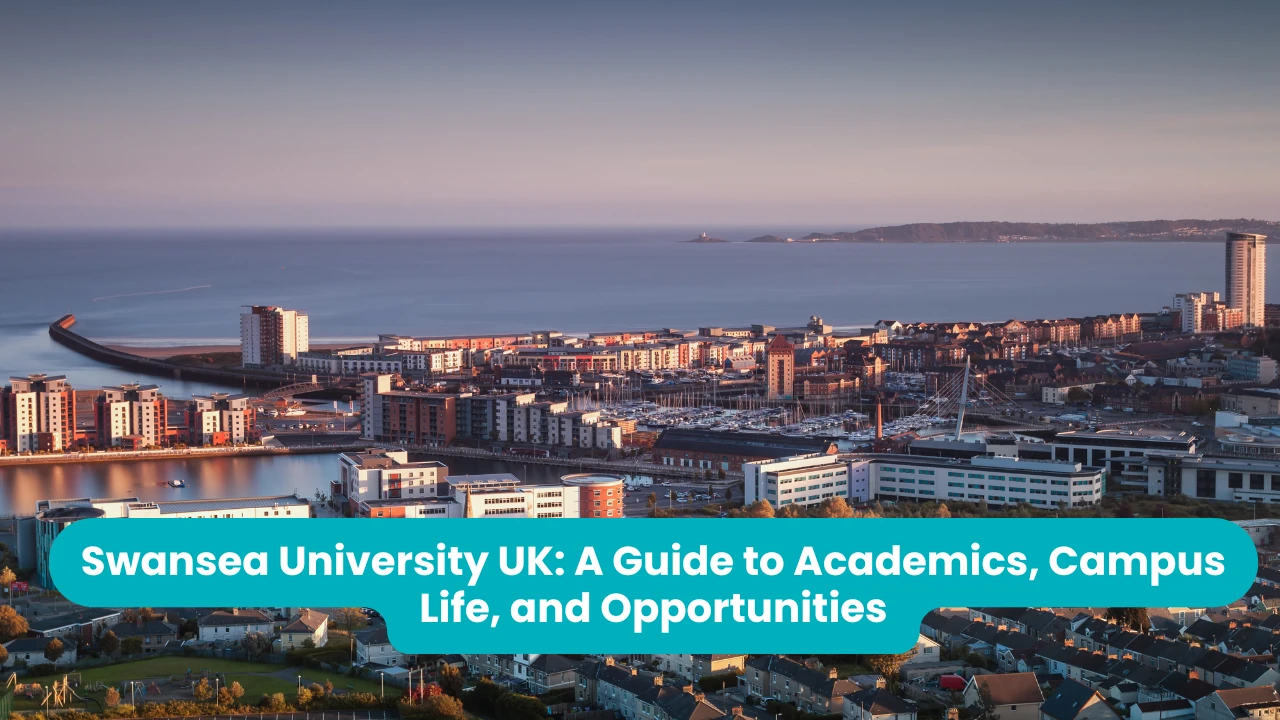
Two campuses, both on the coast, and a smaller city than most UK student destinations.
Singleton Park sits near green space and the seafront; Bay Campus is the newer of the two, with modern facilities and a concentration of engineering, management and science teaching. Which one you spend your time on depends on your course, and it is worth checking before you book accommodation, because the two are not walking distance apart.
The student community is active without being enormous. The university reports over 150 clubs and societies through the Students’ Union, and Swansea University Sport reports over 50 sports clubs with more than 5,000 active members — a high participation rate for a university of Swansea’s size. Surfing and sailing appear on that list for reasons the geography makes obvious.
For an international student the practical advice is unromantic: join two or three societies in the first month. Students who stay inside one familiar friend group struggle disproportionately with confidence, spoken English and the interview stage of a job search, and a smaller city gives you fewer accidental opportunities to correct that than a large one does.
How safe is Swansea, and what is the city like?
Relaxed, small, and cheaper than most of the alternatives — which is the whole point, and also the whole limitation.
Swansea is a coastal city in Wales with a large student presence, and the ordinary UK precautions apply: choose accommodation carefully, avoid isolated areas late at night, use trusted transport after dark, and register with a GP once you arrive and have paid the Immigration Health Surcharge. Our guide to living in the UK as a student covers the arrival admin.
The honest limitation is density. Swansea has fewer employers, fewer part-time roles and fewer professional events within reach than Cardiff, Manchester or London. If you thrive on a quieter environment and a lower cost base, that is a feature. If you were counting on stumbling into opportunities, it is not.
Which courses are worth applying to?
Engineering, computer science and data, health and life sciences, and the business and law programmes with a specialised angle.
The university runs three faculties — Science and Engineering; Medicine, Health and Life Science; and Humanities and Social Sciences — alongside The College, Swansea University, which runs pathway programmes for applicants who do not meet direct entry requirements. A pathway adds cost and time, so treat it as a genuine second option rather than an equivalent route.
Choose the specialised version of a course where one exists. A generic business master’s from a mid-table university competes against thousands of identical degrees in the UK job market; business analytics or health data science does not. That advice holds anywhere, and it holds harder at a university whose name will not open the first door for you.
What scholarships are available?
Partial, but unusually well documented. The International Excellence Scholarship is a tuition discount worth up to £5,000 for the first year, open to overseas students holding an offer for an undergraduate or postgraduate taught course. Undergraduates who receive the full £5,000 can receive a further £2,000 in the second year if they achieve a minimum 70% average in the first.
Eligibility runs on your country of ordinary residence — where you have lived for the last five years, excluding time spent living somewhere purely to study — which catches out applicants who have been studying abroad. Swansea also awards Thrive, Nepal and Sri Lanka bursaries automatically to eligible new international students on taught courses, with no separate application.
Budget on full fees regardless. Our guide to funding your studies in the UK covers the wider calendar.
How do you apply?
Undergraduate applications go through UCAS. Taught postgraduate applications go directly through Swansea’s own system, with transcripts, a degree certificate or provisional certificate, a statement of purpose, a CV where required, references, an English score and a passport copy.
English requirements commonly sit around IELTS 6.0–6.5 overall for master’s programmes, with some courses asking for higher or for specific component minimums. The visa then needs a CAS from Swansea, proof of funds as above, and evidence you meet the English requirement. Our UK application timeline covers the order, and applying to UK universities covers the sequence in more detail.
So is Swansea worth it?
It is, if you want a research-led university at a genuinely low cost base, your subject sits in engineering, computing, health or the sciences, and a smaller city suits how you work. The published cost figures, the 3% fee cap and the REF results together make Swansea one of the more defensible value propositions in the UK, and the transparency alone puts it ahead of universities that will not commit to a number.
It is not, if you need employer density during term or a global brand to do the talking when you go home. Cardiff is the obvious Welsh comparison — Russell Group, larger city, higher cost — and Nottingham Trent and Lancaster are the fairer comparisons on value. Our overview of choosing a university in the UK covers how to weigh them.
To compare Swansea against your realistic alternatives on subject strength, sourced total cost and post-study timing, book a free counselling session.
Frequently Asked Questions
How long can I stay in the UK after graduating from Swansea?
GOV.UK states a Graduate visa lasts two years if you apply on or before 31 December 2026 and 18 months if you apply on or after 1 January 2027, with three years for PhD and other doctoral graduates. It is not a flat two years. Swansea is a smaller employment market than Cardiff or Manchester, so start the job search in the first semester rather than after the dissertation.
What does a year at Swansea actually cost?
The university publishes the figures, which is rare. Its postgraduate cost-of-living page gives university accommodation at GBP 130 to GBP 258 a week, a medium en-suite worked example at GBP 185 a week or GBP 9,620 over 52 weeks plus a GBP 100 reservation deposit, and a private shared-house double room at GBP 122 a week or GBP 6,344 a year with utilities adding about GBP 16 a week.
Do Swansea's tuition fees rise each year?
Yes. The university’s international finances page states that tuition fees are subject to an increase of 3% each year. That is irrelevant on a one-year taught master’s and material across a three-year undergraduate degree. It is also low by sector standards, where 4% and up to 7% caps are both common.
Is Swansea University part of the Russell Group?
No. It is a research-led university in Wales with genuine strength in several subject areas, but it does not carry the Russell Group signal. Judge it on subject strength, research fit, cost and career support rather than on membership. If your plan depends on the label being recognised in a home market, weigh that honestly rather than talking around it.
Where does Swansea University rank?
322nd of 1,504 in the QS World University Rankings 2027 and in the 301 to 350 band in Times Higher Education 2026, against 32nd of 123 in the Guardian 2026, 37th of 131 in the Times 2026 and 41st of 130 in the Complete University Guide 2027. The three UK tables agreeing with each other makes them more trustworthy than any single position.
How strong is research at Swansea?
The university reports 86% of its research rated world-leading or internationally excellent in REF 2021, up from 80% in 2014, with 32% of outputs at the highest 4* level. It also reports 91% of its research environment rated 4* or 3* and 86% of impact judged outstanding or very considerable, with mathematics joint 16th in the UK and geography 20th.
What scholarships can international students get at Swansea?
The International Excellence Scholarship is a tuition discount worth up to GBP 5,000 for the first year, open to overseas students holding an offer for an undergraduate or postgraduate taught course, with a further GBP 2,000 in year two for undergraduates achieving a 70% average. Thrive, Nepal and Sri Lanka bursaries are awarded automatically to eligible new international students with no separate application.
Who counts as eligible for the International Excellence Scholarship?
Eligibility runs on your country of ordinary residence, which the university defines as where you have lived for the last five years, excluding countries where you have lived purely in order to study. That catches out applicants who have spent recent years studying in a third country, so check your own position against the definition before assuming you qualify.
Is Swansea cheaper than London for students?
Substantially. The university states that the cost of living in Swansea is relatively low compared with many other UK cities, and its published weekly accommodation figures are well below typical London student housing. The saving is real, but so is the trade-off in employer density, part-time work availability and professional events within reach.
How much money do I need to show for the Student visa?
GOV.UK requires 1,171 pounds per month for up to nine months for a course outside London, which includes Swansea, held for 28 consecutive days ending within 31 days of your application. Guidance quoting 1,023 pounds is out of date. Check the figure on GOV.UK on the day you assemble your bank statements.
What are the two Swansea campuses and does it matter which one?
Singleton Park sits near green space and the seafront; Bay Campus is newer, with modern facilities and a concentration of engineering, management and science teaching. Which one you spend your time on depends on your course, and they are not walking distance apart. Check before you book accommodation rather than after.
How many societies and sports clubs does Swansea have?
The university reports over 150 clubs and societies through the Students’ Union, and Swansea University Sport reports over 50 sports clubs with more than 5,000 active members, which is a high participation rate for a university of this size. Surfing and sailing appear on the list for reasons the coastal location makes obvious.
Which Swansea courses are best for international students?
Engineering, computer science and data, health and life sciences, and the business and law programmes with a specialised angle. Choose the specialised version where one exists: a generic business master’s competes against thousands of identical UK degrees, while business analytics or health data science does not. That matters more at a university whose name will not open the first door.
Does Swansea offer foundation or pathway programmes?
Yes. The College, Swansea University runs undergraduate and postgraduate pathway options for international students who do not meet direct entry requirements, with progression to a Swansea degree after successful completion. A pathway adds real cost and time, so treat it as a genuine second option rather than an equivalent route to the same place.