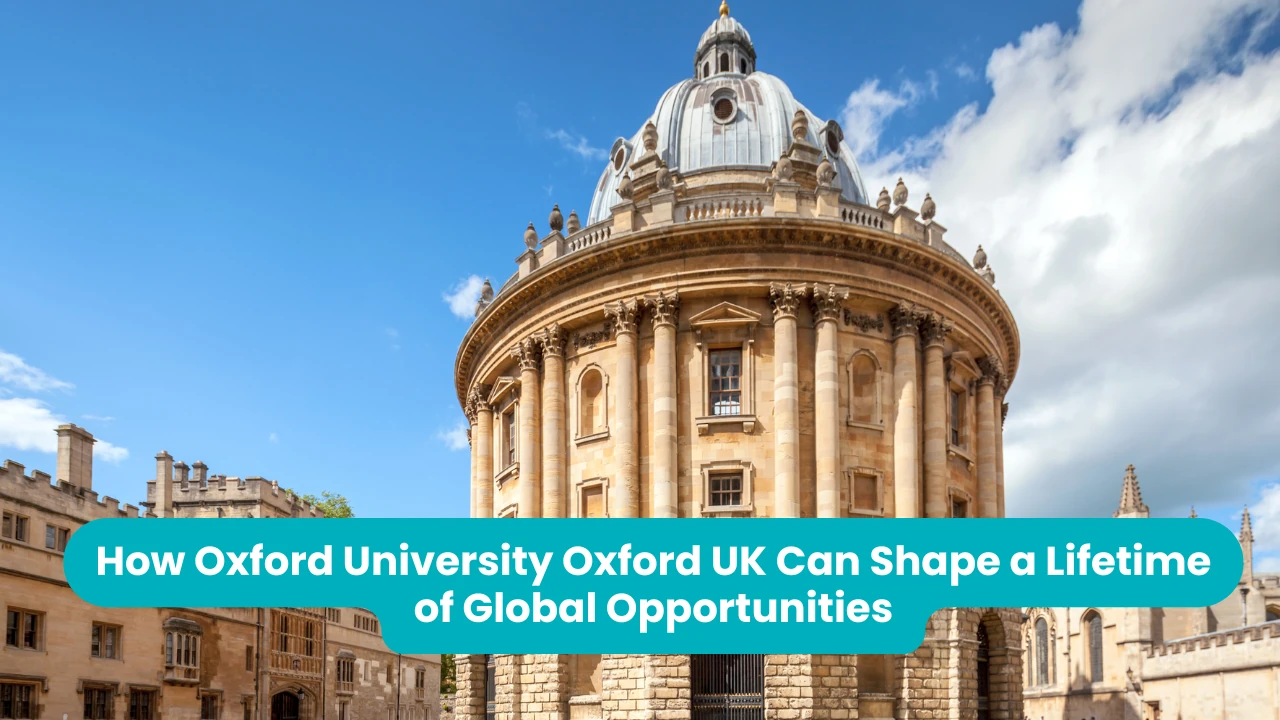
How Oxford University UK Can Shape a Lifetime of Global Opportunities

Key Takeaways
- The Graduate Route is being cut. GOV.UK says a Graduate visa lasts 2 years if you apply on or before 31 December 2026 and 18 months if you apply on or after 1 January 2027, with 3 years for doctoral graduates.
- A one-year master's starting October 2026 finishes in late 2027, so it lands in the 18-month band — a quarter less time to convert the degree into a sponsored job.
- The brand is a screening shortcut that gets your CV read, including in markets that ignore UK league tables. It does not survive an interview you are not ready for.
- Tutorials are the genuinely transferable part: defending an argument weekly to someone who knows the field better than you. It is uncomfortable at first and it is what employers are indirectly buying.
- Budget £45,000–£55,000 for a one-year master's. Course choice often matters more than institution — a specific, in-demand programme elsewhere can beat a generic one at Oxford for less.
Table of Contents
- What has changed about staying on afterwards
- What does the degree actually buy?
- How is the teaching different?
- What does it cost, and how should you think about it?
- What funding exists?
- Which sectors actually hire?
- How should you use the time you have?
- How competitive is admission?
- Is it the right choice for you?
Oxford sells itself. That is the problem with writing about it: the name does so much work that the actual decision — whether a year and roughly £50,000 there beats the alternatives for you specifically — rarely gets made on evidence.
What follows is an attempt at that decision. What the degree genuinely gives an international student, what it does not, how the college and tutorial system differs from anything in Indian higher education, and one change to UK immigration rules that alters the arithmetic for anyone starting a course from now on.
What has changed about staying on afterwards
Start here, because it is time-sensitive and most guidance still has it wrong. The Graduate Route — the visa that lets you stay and work after your degree without a job offer — is being shortened. GOV.UK states that a Graduate visa lasts:
| If you apply | How long it lasts |
|---|---|
| On or before 31 December 2026 | 2 years |
| On or after 1 January 2027 | 18 months |
| With a PhD or other doctoral qualification | 3 years |
You apply after finishing, so a one-year master’s starting in October 2026 finishes in late 2027 and lands squarely in the 18-month band. That is a quarter less time to convert a degree into a sponsored job, and it is the single biggest change to UK study economics in years. The Graduate visa also cannot be extended — you switch to something else, usually a Skilled Worker visa, or you leave. We covered the announcement itself in our note on the shortened post-study visa.
Everything below should be read against that clock.
What does the degree actually buy?
Three things, in descending order of reliability.
A screening shortcut. Recruiters at large firms filter thousands of CVs quickly, and the name gets yours read. This works even in markets that pay no attention to UK league tables, which is why the effect follows you to Dubai, Singapore or back to India rather than expiring at Heathrow.
Recruiter access. Consulting firms, banks, technology companies and policy organisations actively target the university for internships and graduate hiring. Presentations, careers fairs and closed portals put you in front of employers who would otherwise be a cold application.
A dense alumni network. The colleges run mentoring schemes, alumni associations are active in London, Dubai, Singapore, New York and the major Indian cities, and senior alumni circulate roles privately before they reach public boards. This is the part that keeps paying ten years later.
What the degree does not buy is a job. The brand gets the CV read; it does not survive an interview you are not ready for, and under an 18-month window there is less room to find that out slowly.
How is the teaching different?
More different than the rankings suggest, and this is the part that actually changes people.
Oxford teaches through tutorials — small-group sessions in which you defend an essay or a problem set directly to a tutor, weekly. There is nowhere to sit quietly. For students coming from lecture-and-examination systems, the first term is genuinely uncomfortable: you are expected to have read widely, formed a position, and to argue it against someone who knows the field far better than you do.
It is also the most transferable thing on offer. The habit of building an argument under pressure and revising it in real time is what employers are indirectly buying, and it is not something a larger lecture-based programme produces.
The college system does the rest. You live, eat and socialise with students from dozens of countries reading entirely different subjects, which is a more effective cross-cultural education than any module on the subject.
What does it cost, and how should you think about it?
For a one-year master’s, international students should plan for tuition plus living in the region of £45,000–£55,000, with laboratory-based, business and specialist programmes running higher. Verify the current figure on the university’s own fee tables for your specific course, since they vary widely by subject and are revised annually.
The useful framing is not “is Oxford worth it” but “worth it compared with what”:
- Costs. Tuition, living, visa and health surcharge, flights, and the year of earnings you are not having.
- Value drivers. Starting salary, time to first offer, geographic flexibility afterwards, and the trajectory rather than the first number.
- Risk controls. Course choice matters more than institution here — a specific, in-demand programme at a strong Russell Group university frequently beats a generic one at Oxford, and costs less.
Our complete guide to the cost of studying in the UK breaks the categories down, and our master’s in the UK guide covers how to compare programmes rather than names.
What funding exists?
Real, and intensely competitive. The routes worth researching:
- Rhodes Scholarships — fully funded, weighted heavily toward demonstrated leadership and public impact rather than marks alone.
- Graduate scholarships such as Weidenfeld-Hoffmann, which target specific countries and subject areas.
- College-specific and India-focused awards, which are less visible and correspondingly less contested. Individual colleges administer their own funds.
Treat funding as a separate project running in parallel with the application, started early, with its own deadlines. And keep a parallel plan at strong but more affordable universities — the students who end up in a good position are the ones who applied for Oxford funding without depending on it. Our guide to scholarships in the UK covers the wider landscape.
Which sectors actually hire?
| Sector | Typical entry roles |
|---|---|
| Consulting | Analyst, associate, strategy consultant |
| Finance | Investment banking analyst, asset management, risk |
| Technology | Software engineer, data scientist, product manager |
| Research and academia | DPhil, research assistant, postdoctoral fellow |
| Policy and development | Policy analyst, programme officer, international development |
STEM and computing graduates find routes into large technology firms across London, Dublin and the EU hubs as well as high-growth startups. Humanities and social science graduates find policy, development and international organisations more accessible than they would from most universities — but almost always only when paired with relevant internship experience. The degree opens the door; the experience is what gets you through it.
How should you use the time you have?
Deliberately, and from the first week. The compressed UK master’s plus a shortened Graduate Route leaves very little slack.
- Term one. Register with the Careers Service, book an appointment, and identify your target sector. Autumn is when consulting and finance run their graduate cycles, which means applications open before you have settled in.
- Term two. Internships and off-cycle applications. Alumni referrals work best here, and they work best when you ask a specific question rather than for general advice.
- Term three onwards. Dissertation and job search running together. Waiting until the dissertation is finished is the most common and most expensive mistake, and it costs more now than it used to.
Part-time work during term is generally permitted for degree-level students, commonly up to 20 hours a week, but the exact condition is printed on your own visa and varies by course and provider — check yours rather than a general guide, including this one. Treat it as support, not funding. Our guide to UK work visas after graduation covers what comes next.
How competitive is admission?
Very. Many taught master’s courses admit a small minority of applicants, and a strong first class or high 2:1 equivalent is the working floor rather than an advantage. Beyond marks, what separates applications is a statement of purpose that is specific about the course — naming modules, faculty and a reason this programme rather than a similar one elsewhere — and academic references from people who can speak to your work in detail.
Start 12 to 18 months out. That is not padding: admissions tests where required, references, and a statement that has been through several drafts all take longer than expected, and Oxford’s deadlines are earlier than most. Our guide to applying to UK universities covers the sequence.
Is it the right choice for you?
It is, if you have the academic profile, a course with genuine market demand, a funding plan that does not depend on winning a scholarship, and the intention to use the ecosystem actively from day one.
It is not, automatically, simply because you can get in. Some students do better at universities with stronger links to a specific industry, lower costs, or teaching models that suit them better. Compare course outcomes rather than institutional names, and compare them against a shorter post-study window than last year’s guidance assumed. Our overview of UK universities for international students is the place to start that comparison.
To benchmark Oxford against your realistic alternatives on cost, course fit and post-study outcomes rather than on reputation, book a free counselling session.
Frequently Asked Questions
How long can I stay in the UK after graduating?
It depends on when you apply. GOV.UK states a Graduate visa lasts two years if you apply on or before 31 December 2026 and 18 months if you apply on or after 1 January 2027, with three years for PhD and other doctoral graduates. It cannot be extended — you switch to another visa, usually Skilled Worker, or you leave.
Is Oxford a good choice for Indian students planning careers abroad?
Yes, given the academic profile and a realistic funding plan. The brand, recruiter access and alumni network are genuinely global. The decision turns on course fit and cost rather than on reputation, and the shortened post-study window makes choosing a course with clear market demand more important than it was.
How competitive is admission for international master's students?
Very. Many taught courses admit a small minority of applicants, and a strong first class or high 2:1 equivalent is the working floor rather than a differentiator. What separates applications is a statement specific to the course — naming modules and faculty — and references from people who can discuss your work in detail.
Does an Oxford degree guarantee a job in the UK?
No degree does. The Graduate Route gives you a window to work or look for work; Oxford’s advantage is better recruiter access and a network that responds when you use it. Both require action from you, and the window is shorter for anyone applying from 2027.
What does a one-year master's cost?
Plan for roughly £45,000 to £55,000 including tuition and living costs, with laboratory-based, business and specialist programmes higher. Verify the current figure on the university’s own fee table for your specific course, and budget separately for the visa, the immigration health surcharge and exchange rate movement.
Can I work part-time during my studies?
Degree-level students are generally permitted term-time work, commonly up to 20 hours a week, but the precise condition is stated on your own visa and varies by course and provider. Check yours rather than a general guide. Treat any earnings as support, not as part of your funding plan.
Are there fully funded scholarships for Indian students?
Yes, and competition is intense. Rhodes Scholarships, Weidenfeld-Hoffmann and college-specific or India-focused awards can be fully funded. They reward demonstrated leadership and impact alongside academics. Apply, but keep a parallel plan at strong and more affordable universities rather than depending on the outcome.
How does Oxford compare with other Russell Group universities?
Oxford sits at the top for global brand recognition and recruiter targeting. Several other Russell Group universities deliver excellent employability at lower cost and with less competitive admission, sometimes with stronger links to a specific industry. Compare outcomes for the specific course rather than the institution overall.
Can I move to other countries after studying at Oxford?
Yes. The degree is well recognised in Canada, Europe, the US, Singapore and the Gulf. Many graduates use the Graduate Route first and then move through skilled worker visas or an internal employer transfer. The brand’s portability is one of the more durable arguments for the cost.
How is the teaching different from Indian universities?
Oxford teaches largely through tutorials — small-group sessions where you defend an essay or problem set to a tutor, weekly. It demands independent reading and a position you are willing to argue. For students used to lecture-heavy systems the adjustment is demanding, and it is the part most graduates say changed how they think.
Is Oxford worth it for non-STEM subjects?
Yes, particularly for policy, research, academia, law and international organisations, where the tutorial system’s analytical and communication training is directly valued. Be specific about the career pathway before committing, since some fields need further professional qualifications after the degree.
How early should I start preparing my application?
Twelve to eighteen months before your intended intake. Oxford’s deadlines fall earlier than most UK universities, and admissions tests where required, academic references and a statement that has been through several drafts all take longer than people plan for.