PTE vs IELTS: Which Is Easier, and Which Should You Take?


Key Takeaways
- Neither test is easier for everyone. PTE Academic takes about 2 hours on a computer with AI scoring; IELTS Academic takes 2 hours 45 minutes and its Speaking test is a face-to-face interview with an examiner.
- Pearson's July 2025 concordance links the two scales: IELTS 6.5 is PTE 55 to 62, and IELTS 7.0 is PTE 63 to 70. Always use the minimum score your university or visa sets.
- Both tests usually return results within 2 days: PTE typically, and most IELTS on computer results. Both scores are treated as valid for 2 years.
- For Canada permanent residency, IRCC accepts PTE Core and IELTS General Training, not PTE Academic or IELTS Academic. For UK visas, book PTE Academic UKVI or IELTS for UKVI.
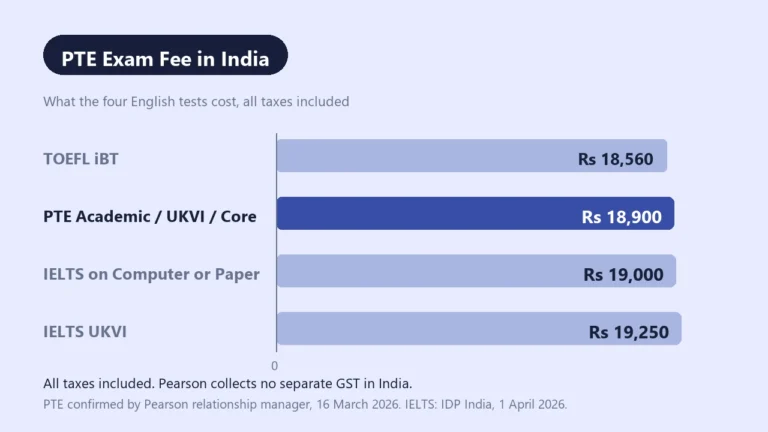
- In India the fees are almost the same: PTE Academic is ₹18,900 including all taxes and IELTS on Computer is ₹19,000, so choose on format and acceptance, not cost.
Table of Contents
Neither test is easier for everyone. PTE Academic is shorter (about two hours), taken entirely on a computer and scored by Pearson’s AI system, with results typically in two days. IELTS Academic takes 2 hours 45 minutes, and its Speaking test is a face-to-face conversation with a certified examiner. Which one feels easier depends on how you handle a microphone and a timer versus a person across the table.
Before you compare difficulty, check one thing: does the university or visa you are applying for accept both? Most universities in Australia, Canada, New Zealand and the UK accept either test. Canada’s permanent residency programmes are the big exception, and they want a different version of each test. The sections below take format, scoring, results, acceptance and cost in turn, using Pearson’s and IELTS’s own pages, read on 28 October 2026.
What is the difference between PTE and IELTS?
Both tests measure Listening, Reading, Writing and Speaking for study, work and migration. They differ in how long they take, who marks your Speaking, and how the score is reported.
| Feature | PTE Academic | IELTS Academic |
|---|---|---|
| Run by | Pearson | British Council, IDP IELTS and Cambridge University Press & Assessment |
| Test time | About 2 hours, in one sitting | 2 hours 45 minutes |
| Parts | Speaking & Writing (76–84 min), Reading (23–30 min), Listening (31–39 min) | Listening (about 30 min), Reading (60 min), Writing (60 min), Speaking (11–14 min) |
| Speaking | Recorded into a microphone at the computer | Face-to-face interview with a certified examiner, recorded |
| Marking | AI scoring; some responses are also reviewed by a human expert | Examiners mark Writing and Speaking against four published criteria |
| Score scale | 10 to 90, overall and per skill | Band 1 to 9, overall and per section, in half bands |
| Results | Typically within 2 days | Most IELTS on computer results within 2 days |
| Score valid for | 2 years from the test date | IELTS recommends 2 years |
Sources: Pearson, PTE Academic and PTE Academic scoring; IELTS Academic test, IELTS fast results and IELTS scoring in detail. All read 28 October 2026.
For the full section-by-section breakdown of PTE, see our PTE exam pattern guide.
Is PTE easier than IELTS?
PTE is not an easier test; it is a different kind of test. The level of English a university asks for is the same whichever test you take, and the two score scales are linked by Pearson’s own research (see the next section). What changes is the experience on the day, and that is where students find one or the other easier.
PTE often suits you if:
- You are comfortable speaking to a computer under a countdown, without a person reacting to you.
- You type faster than you handwrite, and you like short, timed tasks.
- You need a score quickly, for a deadline or a visa application.
- You would rather sit one two-hour test than a longer one.
IELTS often suits you if:
- You speak better in a real conversation, where the examiner can ask a follow-up question.
- You prefer longer reading passages and essays to many short tasks.
- You want each skill tested on its own, rather than tasks that score two skills at once.
- The organisation you are applying to names IELTS, or names a specific IELTS band.
One difference catches many students out. In PTE, several tasks count towards more than one skill: Pearson says Read Aloud affects both your reading and speaking scores, and Repeat Sentence affects both listening and speaking, so one weak skill can pull down two scores. In IELTS, each section is marked separately, and the overall band is the average of the four section bands, rounded to the nearest half band.
The best way to find out which suits you is to try both formats under timed conditions. Our free PTE practice test and free IELTS mock test let you do that before you book.
How do PTE scores compare to IELTS bands?
Pearson publishes a concordance between PTE Academic and IELTS Academic, updated in July 2025 for the current PTE test. These are the rows most universities ask about:
| IELTS Academic band | PTE Academic overall score |
|---|---|
| 6.0 | 47–54 |
| 6.5 | 55–62 |
| 7.0 | 63–70 |
| 7.5 | 71–78 |
| 8.0 | 79–85 |
The full table, including section-by-section scores and CEFR levels, is on our PTE score chart. Pearson is clear that the concordance does not set anyone’s entry requirement: universities and visa programmes publish their own minimum scores, and you should always use theirs. To turn your own section scores into an overall result, use the PTE score calculator or the IELTS band calculator.
How is the Speaking test different?
This is the biggest practical difference between the two tests.
In IELTS, Speaking is an 11 to 14 minute interview with a certified examiner, in three parts: questions about familiar topics, a two-minute talk on a task card after one minute of preparation, and a discussion. The examiner scores fluency and coherence, lexical resource, grammatical range and accuracy, and pronunciation.
In PTE, you speak into a microphone at a computer, in the same sitting as the Writing tasks. Tasks include Read Aloud, Repeat Sentence, Describe Image, Retell Lecture, Answer Short Question, Summarize Group Discussion and Respond to a Situation. Each has a short preparation countdown, and the microphone opens after a tone. Pearson’s AI scores content, pronunciation and oral fluency, and a human expert also reviews the content of some tasks.
If you freeze when a microphone opens, IELTS may feel easier. If you are nervous talking to a stranger, PTE may.
How is the Writing test different?
IELTS Academic Writing has two tasks in 60 minutes. In Task 1 you describe a graph, table, chart or diagram in at least 150 words (about 20 minutes). In Task 2 you write an essay of at least 250 words (about 40 minutes). In the computer-delivered test you type; IELTS also offers a Writing on Paper option where you write by hand.
PTE Academic Writing is part of the Speaking & Writing section. Summarize Written Text asks you to sum up a passage, and Write Essay asks for 200 to 300 words in 20 minutes. Pearson gives full marks for form only when the essay stays between 200 and 300 words, so going over the limit costs points.
Which test is accepted where?
For universities, both are widely accepted. Pearson says PTE Academic is accepted by more than 4,000 universities and colleges, including virtually all universities in Australia, Canada, New Zealand and the UK and all Ivy League universities. IELTS says over 13,500 organisations worldwide accept its results. Always check the specific course page, because some programmes still name one test only.
For visas, the rules depend on the country:
| Purpose | PTE | IELTS |
|---|---|---|
| Australia and New Zealand visas | PTE Academic, accepted by Home Affairs and Immigration New Zealand | IELTS |
| UK work visas and study below degree level | PTE Academic UKVI | IELTS for UKVI |
| Canada permanent residency (Express Entry) | PTE Core, not PTE Academic | IELTS General Training, not IELTS Academic |
Our PTE accepting countries guide covers country-by-country acceptance in more detail. If you are also weighing TOEFL or Duolingo, see our four-test comparison and PTE vs TOEFL.
How much do PTE and IELTS cost in India?
| Test | Fee in India | Source |
|---|---|---|
| PTE Academic | ₹18,900 | Our Pearson relationship manager, inclusive of all taxes, revised 16 March 2026 |
| IELTS on Computer (Academic or General Training) | ₹19,000 | IDP India, updated 1 April 2026 |
The fees are almost the same, so cost should not decide it. Our PTE exam fee guide and IELTS exam fee guide cover rescheduling, cancellation and the other variants. If you choose PTE, you can lower the fee with our PTE voucher code, and the PTE registration guide walks through booking.
How should you choose between PTE and IELTS?
- Confirm that every university and visa on your list accepts the test, and note the minimum score each one asks for.
- Take one free timed practice test in each format and compare your results using the concordance above.
- Pick the format where you scored higher, or felt more in control, and check test dates near you.
- Leave time for a retake before your deadline. PTE results usually arrive in about two days, and most IELTS on computer results do too.
If your test choice is part of a wider application plan, our admissions counsellors can check your shortlist’s English requirements with you. For structured preparation, see PTE preparation and IELTS preparation.
Frequently Asked Questions
Is PTE easier than IELTS?
Not in the level of English it asks for. The two score scales are linked by Pearson’s concordance, so a university asking for IELTS 6.5 effectively asks for PTE 55 to 62. Students who are comfortable with computers and timed tasks often find PTE easier; students who speak better in conversation often prefer IELTS.
What is the main difference between PTE and IELTS?
PTE Academic is fully computer-based and AI-scored, with Speaking recorded into a microphone. IELTS Academic has a face-to-face Speaking interview with a certified examiner, and examiners mark Writing and Speaking. PTE takes about 2 hours; IELTS takes 2 hours 45 minutes.
What PTE score is equal to IELTS 7?
According to Pearson’s concordance, updated in July 2025, IELTS Academic 7.0 corresponds to a PTE Academic overall score of 63 to 70. Our PTE score chart has the full table, including section scores.
What PTE score is equal to IELTS 6.5?
IELTS Academic 6.5 corresponds to a PTE Academic overall score of 55 to 62 in Pearson’s July 2025 concordance.
Which test gives results faster, PTE or IELTS?
They are close. Pearson says PTE Academic results arrive typically within 2 days. IELTS says most IELTS on computer results are now issued within 2 days.
Is PTE accepted everywhere IELTS is accepted?
Not everywhere, but widely. Pearson says PTE Academic is accepted by more than 4,000 universities and colleges, including virtually all universities in Australia, Canada, New Zealand and the UK. IELTS says over 13,500 organisations accept its results. Check each course page, because some still name one test.
Can I use PTE or IELTS for Canada PR?
Yes, but not the academic versions. IRCC accepts PTE Core and IELTS General Training for Express Entry. PTE Academic and IELTS Academic are not accepted for permanent residency.
Which test should I take for a UK visa?
For UK work visas and study below degree level you need a UKVI-approved test: PTE Academic UKVI or IELTS for UKVI. Many UK universities accept standard PTE Academic or IELTS Academic for degree courses, so check your university’s requirement.
How much do PTE and IELTS cost in India?
PTE Academic costs ₹18,900 including all taxes, according to our Pearson relationship manager (revised 16 March 2026). IELTS on Computer costs ₹19,000 according to IDP India (updated 1 April 2026).
How long are PTE and IELTS scores valid?
Pearson says a PTE Academic score is valid for two years from the test date. IELTS recommends that results are considered valid for two years after the test. Some organisations set their own rules.
Is the PTE Speaking test with a person?
No. In PTE you speak into a microphone at a computer, and your responses are scored by Pearson’s AI system, with a human expert reviewing the content of some tasks. In IELTS, Speaking is an 11 to 14 minute interview with a certified examiner.
Is there an essay in both PTE and IELTS?
Yes. PTE Academic’s Write Essay asks for 200 to 300 words in 20 minutes, and going outside that range loses marks. IELTS Academic Writing Task 2 asks for at least 250 words in about 40 minutes, alongside a Task 1 report on a chart or diagram.